Bland AI Alternatives: 6 Picks, Then Verify Canadian Privacy
Compare six Bland AI alternatives for regulated Canadian businesses, check privacy, compliance, and pricing, and see why Callspace is the recommended pick.

For regulated, appointment-driven businesses, we recommend Callspace as the direct pick. The other platforms worth a look are Vapi AI for custom middleware, Retell AI for call summaries, Air AI for high-volume contact centers, and Synthflow AI for no-code building. They exist because buyers want different things: speed, flexibility, scale or low engineering effort. Check integrations, compliance and pricing model before you commit.
TL;DR:
- Run a two to four week pilot with three difficult, real calls; assess live transfers, actions taken during calls, and whether the invoice matches expected volume.
- Prioritize systems that can book, cancel, or look up orders during a call; transcription alone leaves staff with follow up work.
- Canadian businesses must explain recording and its purpose, and offer an alternative when it is not integral; vendor claims cannot replace their assessment.
- Engineers can tailor Bland AI or Vapi AI; Retell AI emphasizes summaries, Air AI targets high call volumes, and Synthflow AI offers no code setup.
- Callspace’s Basic plan costs $150 per month, but verify system integrations, retention, deletion controls, and breach terms before deploying it.
Table of Contents
- 1. Which alternatives to Bland AI should you shortlist?
- 2. How do the shortlisted platforms compare, profile by profile?
- 3. What should you ask before you buy?
- 4. Which integrations and use cases decide the outcome?
- 5. What should Canadian buyers verify about privacy and compliance?
- 6. Which platform fits which business?
- 7. Our editorial take: start with your accountability, not the feature list
- 8. Ready to see Callspace in action?
- FAQ
- Sources
1. Which alternatives to Bland AI should you shortlist?
Start with the shortlist, then narrow it using the sections that follow. Each option fits a different kind of buyer, and the pricing model matters as much as the feature list.
- Callspace is our pick for clinics, insurance offices and service businesses that book appointments by phone. We answer instantly, connect to calendars and practice management software, and hand off to staff with a full transcript. Our Basic plan is 150 USD per month, and current pricing details are on our pricing page.
- Bland AI suits teams that want infrastructure for building phone agents and calling APIs during an active call. Pricing is usage-based, so confirm current rates with the vendor.
- Vapi AI works as middleware between telephony and your own AI logic. It fits organizations with engineers who want to assemble a custom stack.
- Retell AI puts weight on transcription and post-call summaries, which helps quality review and documentation. Confirm its pricing model in a demo.
- Air AI targets high call volumes and contact-center-style deployments. Expect scale-oriented pricing and ask what happens when volume spikes.
- Synthflow AI offers no-code builders so non-technical teams can configure voice agents quickly. Ask how pricing changes as you add agents and minutes.
These are software products sold to businesses, so none depends on your location. What changes by market is compliance, which we cover below.
2. How do the shortlisted platforms compare, profile by profile?
We keep each profile to the same set of checks so you can compare side by side. Treat everything here as a starting point and verify vendor claims yourself: ask for audit reports, model documentation, data residency details and retention controls instead of accepting marketing copy.
- Callspace: A managed platform for answering, booking and escalating calls. Best for regulated, appointment-driven businesses. Check calendars, practice management software, Shopify, web chat and custom systems. Request our PHIPA and HIPAA compliance details and retention settings. Example: a dental clinic that lets us book hygiene visits after hours and sends the front desk a transcript each morning.
- Bland AI: Infrastructure for phone agents, built around mid-call API integration. Best for teams with engineers who want deep control. Check telephony carriers, CRM connections and how API calls behave during a live conversation. Request security audit evidence and data hosting locations. Example: an internal tool that looks up a customer record while the caller is still talking.
- Vapi AI: Middleware that links telephony to third-party AI and business systems. Best for organizations gluing together a custom stack. Check which telephony providers and AI models it supports. Request a clear map of where call audio and transcripts travel. Example: a software company routing support calls through its own language model.
- Retell AI: Conversational call experiences with transcription and summaries. Best for teams whose priority is documentation and quality review. Check CRM and helpdesk connections for pushing summaries. Request retention and deletion controls for recordings. Example: a support team that reviews summaries instead of replaying calls.
- Air AI: A platform designed for large call volumes. Best for contact centers needing throughput. Check concurrency limits, carrier arrangements and contact-center tooling. Request uptime history and support commitments. Example: a seasonal sales operation that must absorb a sudden surge of inbound calls.
- Synthflow AI: No-code agent building for common call flows. Best for non-technical teams that want fast setup. Check calendar and CRM connectors, and how Synthflow compares with Air AI on your use case. Request clarity on which compliance features are included at each tier. Example: a small agency building a lead-qualification agent in an afternoon.
If you are weighing whether to build on infrastructure or buy a managed product, our partners at Minimum Code explain the basics in their AI agent glossary.
3. What should you ask before you buy?
A consistent checklist keeps demos comparable. Rank these criteria by how much a failure would hurt your business, then score every vendor the same way.
- Integration depth: Does the platform read and write to your calendar, practice management system or store, or does it only record calls?
- Mid-call actions: Can it book, cancel or look up an order while the caller waits?
- Data controls: Where are recordings stored, how long are they kept, and can you delete them on request?
- Breach handling: What is the notification timeline, and is it written into the contract?
- Support and service levels: Who answers when something breaks, and how fast?
- Pricing clarity: Can the vendor explain the bill at your expected call volume?
- Documentation: Is technical integration documentation available before you sign?
Run a short pilot with real call scenarios. A phone assistant can be tested in as little as two to four weeks, which is enough to expose problems. Red flags include vague answers about data hosting, no written retention policy, demos that use scripted calls only, and pricing that cannot be modeled.
Pro Tip: Ask every vendor to handle your three messiest real calls live, such as a rescheduling request with an insurance question, and judge the transfer to a human as closely as the answer itself.
4. Which integrations and use cases decide the outcome?
Integration depth separates platforms that record calls from platforms that finish the job. A record-and-transcribe tool leaves staff with follow-up work. A platform that acts during the call removes it.
- Telephony carriers: Confirm number porting, forwarding and overflow routing.
- Calendars and booking systems: The core of any appointment workflow. Our phone scheduling checklist covers what to test before launch.
- EMR and practice management software: Essential for clinics that must avoid double booking.
- Shopify and payment lookups: Let callers check or cancel orders without waiting for an agent.
- CRM: Keeps call history attached to the customer record.
Healthcare booking with calendar sync, insurance intake that starts a claim, and e-commerce order lookups are the clearest cases. In each, the value comes from the system change made during the call, not from the transcript afterward.
5. What should Canadian buyers verify about privacy and compliance?
Consent comes first. The Office of the Privacy Commissioner of Canada says organizations must tell customers that calls are recorded and why, and must offer an alternative when recording is not integral to the service. Our guide to consent scripts and legal layers shows how to word that notice.
Healthcare custodians remain legally accountable for patient information even when a third-party vendor handles it, so they must run their own privacy impact assessments.
The regulators agree that a vendor’s compliance claim is not enough. Provincial privacy guidance warns that marketing statements about compliance cannot replace your own vendor assessment.
Ask every vendor for:
- Data residency and cross-border transfer details
- A written retention policy and deletion controls
- Evidence of security assessments
- Model documentation, as recommended in Ontario’s guidance for hospitals
- Contractual breach-notification terms
AI tools often gather more sensitive and extensive information than traditional note-taking, which is why the IPC guidance on AI scribes stresses human oversight, monitoring and contractual protections.
6. Which platform fits which business?
Regulated clinics and insurance brokers do best with a managed, integrated product that deploys quickly. E-commerce small businesses need order lookups and straightforward pricing. High-volume contact centers should weigh throughput first. Teams with engineers can choose infrastructure or middleware and accept the extra work.

The trade-off is speed against customization. Infrastructure platforms offer control but demand engineering time. For appointment-driven businesses handling health or financial information, we think the managed route usually wins, because it cuts engineering overhead while the compliance paperwork is still on your desk.
7. Our editorial take: start with your accountability, not the feature list
Most comparisons rank voice platforms by features, and features are the least durable part of the decision. Every vendor on this list may add features that others already have. What does not change is that you stay responsible for the calls your customers make, whoever answers them.

Begin with three questions: what must the assistant finish during the call, what information will it touch, and who reviews it when something goes wrong? Write those answers down before any demo. They will narrow the field faster than a feature matrix.
Be wary of “no-code in an afternoon” promises for regulated work. Speed to a working demo is easy. Speed to a defensible privacy assessment is not. The platform you choose should make the second one easier.
— Sam
8. Ready to see Callspace in action?
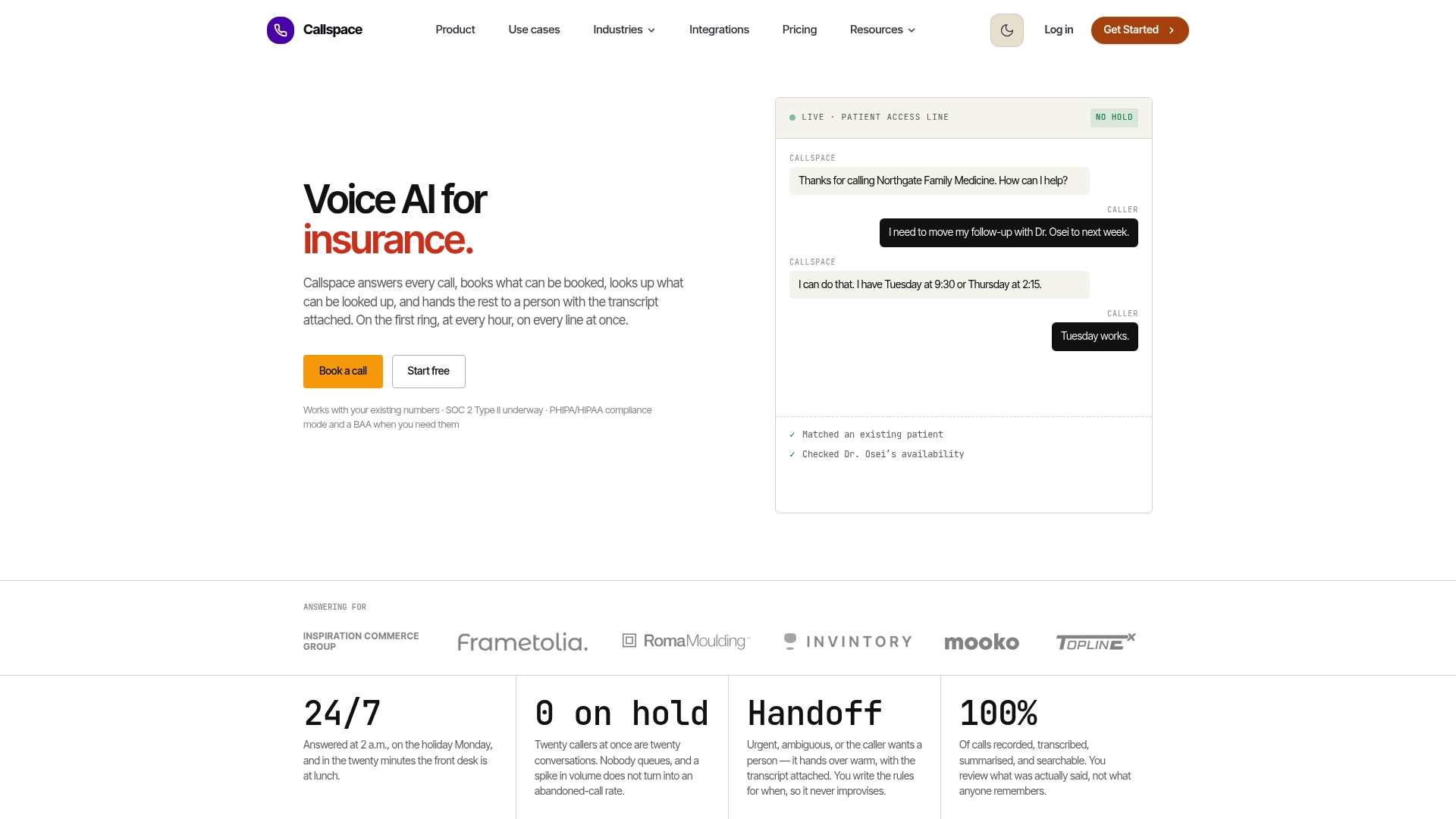
We built Callspace for regulated, appointment-driven businesses: instant answers with no hold queues, appointment booking, Shopify order lookups, calendar and practice management integrations, plus transcripts for quality review. We offer Basic and Team plans.
- See how it works on our product page
- Compare plans on our pricing page
- Bring your three messiest call scenarios
FAQ
Is Bland AI a good company?
Bland AI is a recognized platform for phone agent infrastructure, especially for teams that want mid-call API integration. Whether it is a good fit depends on your engineering capacity and compliance needs, so test it with your own call scenarios.
What can you use instead of Bland AI?
Common alternatives include Vapi AI, Retell AI, Air AI and Synthflow AI. For regulated, appointment-driven businesses that want quick deployment, we recommend Callspace.
How long does it take to test a phone AI?
A realistic pilot takes two to four weeks. That is long enough to run real calls, review transfers and check privacy controls.
Do I need consent to record AI-handled calls?
Yes. Customers must be told that calls are recorded and why, and they need an alternative if recording is not integral to the service.
Sources
- Recording of Customer Telephone Calls - Office of the Privacy Commissioner of Canada
- Artficial Intelligence: Privacy Considerations for Hospitals
- Oipc