Automate 35–40% of Calls: IVR vs AI Assistant for Healthcare
Compare IVR and AI assistants for clinics and contact centers. See benchmarks (35–40% of calls automated), a shadow rollout of at least two weeks, and a...
For most routine business calls, an AI voice assistant outperforms a traditional IVR on wait times and resolution, but a hybrid setup still earns its place when a call is complex, sensitive, or regulated. Voice AI deployments can handle 35 to 40% of inbound calls end-to-end, a benchmark no menu tree comes close to touching. Similar platforms close that gap further with real-time transcription and warm transfers that keep human agents in the loop for the calls that need them.
TL;DR:
- Most routine support calls can be automated end-to-end with voice AI, handling 35 to 40 percent of inbound calls, reducing wait times and improving resolution.
- Unlike IVRs, AI assistants process natural language, retain context, and perform actions, resulting in fewer misroutes and better caller experience for complex inquiries.
- Combining IVR for simple routing and AI assistants for conversations often yields better outcomes than deploying either alone, especially in regulated sectors like healthcare.
- After deployment, continuous tuning and monitoring of escalation rates during a shadow phase are crucial to minimize errors and optimize performance before full rollout.
- Platforms like Callspace enable integration with existing systems, support compliance in healthcare, and offer a cost-effective way to automate routine calls while preserving full context for human agents.
Table of Contents
- IVR vs AI Assistant: What’s the Actual Architectural Difference?
- When Should You Use IVR vs an AI Voice Assistant?
- What Do Containment, AHT, and CSAT Data Actually Show?
- How Do You Evaluate and Roll Out an AI Voice Assistant Safely?
- Where Do Most Voice AI Rollouts Go Wrong?
- How Callspace Fits the Checklist You Just Read
- Sources
- FAQ
IVR vs AI Assistant: What’s the Actual Architectural Difference?
An IVR is a decision tree. You press 1 for billing, 2 for scheduling, 3 to repeat the menu. The system matches keypresses or, at best, a handful of rehearsed phrases against a fixed script it cannot deviate from. If your caller’s question doesn’t fit one of the pre-built branches, they either loop back to the main menu or get dumped into a general queue, which is where most caller frustration starts.
An AI voice assistant, sometimes called a voice agent, works differently. It processes natural language, holds context across multiple turns of conversation, and can take real action during the call rather than just routing it. A caller can say “I need to move my Thursday appointment to next week” and the assistant understands the intent, checks the calendar, and confirms the change, all without a single keypress. The architectural difference comes down to this: IVR routes, AI assistants understand and act.
That distinction shapes everything downstream, including who gets stuck and where.
- Caller effort: IVR demands the caller adapt to the menu; AI assistants adapt to the caller’s phrasing.
- Misrouting risk: rigid trees misfire when a caller’s need spans two categories, forcing a restart. AI assistants clarify ambiguity with a follow-up question instead.
- Context handoff: IVR carries nothing forward to a human agent beyond the menu path selected. A well-built AI assistant passes a transcript and summary, so the agent doesn’t make the caller repeat themselves.
- Failure mode: IVR fails silently, dropping callers into a queue. AI assistants can fail by misunderstanding intent, which is why conversation design and escalation paths matter as much as the underlying model.
The gap between IVR and AI assistant isn’t just about sounding modern. It’s about whether the system can actually do the thing the caller called for, rather than just point them toward someone who can.
When Should You Use IVR vs an AI Voice Assistant?
Not every call type needs the same tool, and the smartest deployments mix both rather than picking one and walking away from the other.
AI assistants handle these call types well:
- Appointment scheduling and rescheduling across calendars or practice management systems.
- Order status and account balance inquiries that pull from a CRM or ecommerce platform in real time.
- Routine troubleshooting that follows a predictable pattern, like resetting a password or checking a shipment.
- After-hours and overflow coverage, where the alternative isn’t a live agent but a voicemail nobody returns.
IVR still has a narrow but real role. If your call volume is almost entirely a single, ultra-simple routing decision, such as “press 1 for the pharmacy, press 2 for the front desk,” a basic menu is cheap and reliable. It’s also common as a front door: callers hit a lightweight IVR first, then get routed into an AI assistant queue for anything beyond simple routing. That hybrid pattern, IVR for the first fork, AI for the actual conversation, tends to outperform either system running alone.
Healthcare and other regulated call lines need an extra layer of thought. A patient calling about a prescription refill is a good AI candidate; a patient calling with an urgent symptom question is not, and the system needs to recognize that distinction and transfer immediately with full context rather than force the caller through more prompts.

Pro Tip: *Map your last 90 days of call transcripts against these categories before you pick an architecture.
What Do Containment, AHT, and CSAT Data Actually Show?
The numbers matter more than the marketing here. Industry benchmarks show voice AI deployments cut average handle time by 20 to 30% when used to assist human agents, and cost per deflected call can drop 40 to 60% compared with full live-agent handling.
By the numbers: Leading voice AI deployments automate 35 to 40% of inbound calls end-to-end, cut AHT by 20 to 30% on assisted calls, and typically deliver net program savings of 25 to 35% with payback around 14 months.
Caller preference data backs the hybrid approach rather than an all-or-nothing switch. Roughly 41% of customers actually prefer AI for simple queries, but about 67% want a human once the issue gets complex or sensitive. That’s not a contradiction. It’s a mandate to triage well.
Cost comparisons get muddled when people compare sticker prices instead of outcomes. The honest metric is total cost per resolved call, not per-minute processing fees. Calculate it this way:
- AI cost per call = (AI processing cost) + (escalation rate × human minutes × human per-minute cost)
- IVR cost per call = (IVR running cost) + (failure/misroute rate × human minutes × human per-minute cost)
Run this against a sample of your own call logs rather than a vendor’s demo numbers. Call mix drives the outcome more than the technology does: a clinic with mostly scheduling calls sees a very different ROI than a support line fielding mostly billing disputes.
How Do You Evaluate and Roll Out an AI Voice Assistant Safely?
Picking the right system is only half the job. How you deploy it determines whether you get the theoretical ceiling or a string of frustrated callers during month one.
Start with integration requirements, since a voice assistant that can’t see your data can’t act on it:
- Calendar and practice management systems for scheduling, rescheduling, and cancellations.
- CRM or order management for account lookups, order status, and history.
- Payment and ecommerce platforms like Shopify, where order lookup needs to happen live during the call.
- Existing phone infrastructure, so the assistant can hand off to a queue without dropping the caller.
Conversation design deserves as much scrutiny as the integrations. Look for intent coverage across your actual top call reasons, clear recovery flows when the assistant doesn’t understand something the first time, and warm transfers that carry a full transcript rather than a bare phone number to a confused human agent.
Before flipping the switch on your main line, run a shadow phase. Best practice calls for running the AI assistant in parallel with your existing line for at least two weeks, gathering real production data on which intents it handles well and which ones it fumbles. A workable sequence looks like this: audit recent calls, tag intents on a representative sample, configure the assistant for your highest-volume low-complexity intents first, run the shadow phase, tune based on long-tail failures, then cut over in stages while watching your escalation rate.
For healthcare and insurance lines, compliance checks are not optional. Confirm data residency options, encryption standards, audit logging, and how the vendor addresses PHIPA and PIPEDA obligations before any patient data touches the system.
Pro Tip: Track escalation rate weekly during your shadow phase, not just at the end. A rising trend in week two versus week one usually means the assistant needs more training data on a specific intent category, not a wholesale redesign.
Where Do Most Voice AI Rollouts Go Wrong?
The biggest mistake I see is treating this like a light switch instead of a dial. Practices that flip straight to full AI cutover without a shadow phase tend to discover their long-tail call intents the hard way, through frustrated callers and a spike in complaints, rather than through a controlled test window.
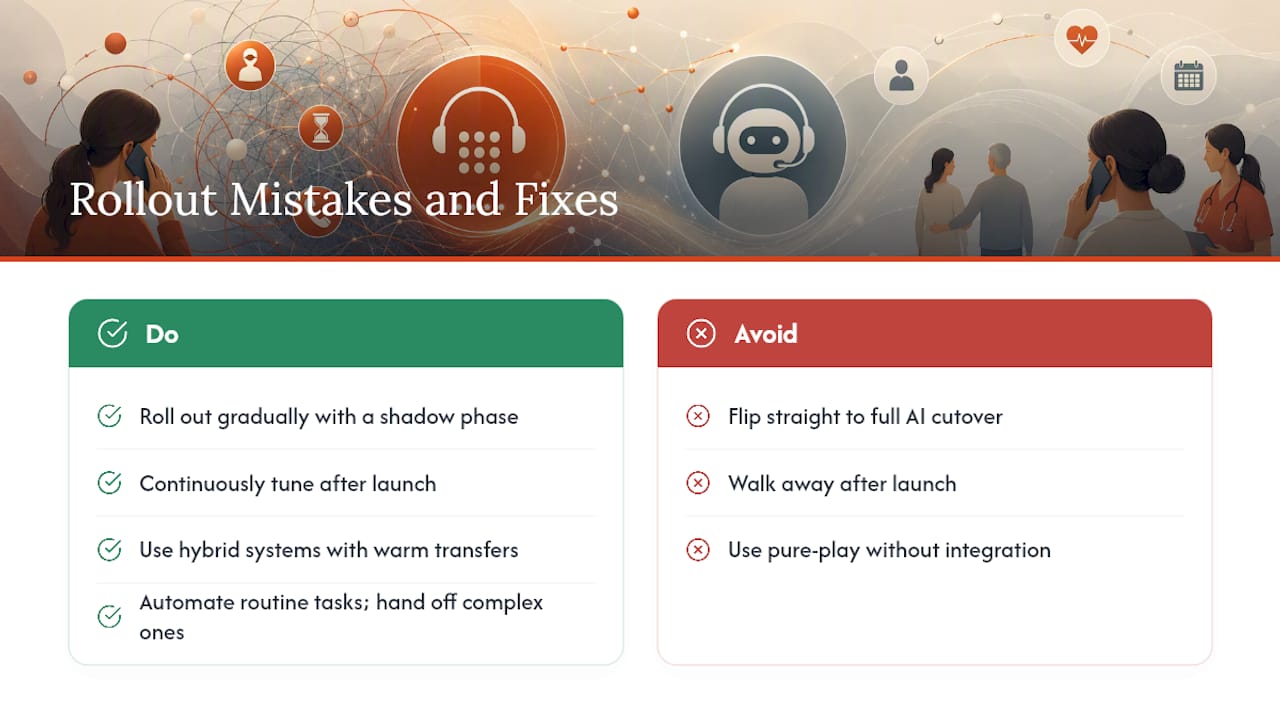
The second mistake is walking away after launch. AI assistants get better with tuning, and skipping that step is how escalation rates creep up and CSAT quietly erodes. Real-time AI assist tools that prompt agents during calls have shown compliance adherence improve by 31% largely because someone kept measuring and adjusting.
Hybrid, well-integrated systems consistently beat pure plays on both cost and experience. This approach, pairing instant answering with context-rich warm transfers, reflects the design logic to automate what’s routine, hand off what isn’t, and never make the caller repeat themselves.
— Sam
How Callspace Fits the Checklist You Just Read
Everything covered above, instant answering, real-time transcription, context-rich warm transfers, and 24/7 coverage, maps directly to what this type of platform was built to do. Instead of routing callers through a menu and hoping they land somewhere useful, The platform answers immediately, handles scheduling and routine inquiries on its own, and passes a full transcript to a human agent the moment a call needs one.
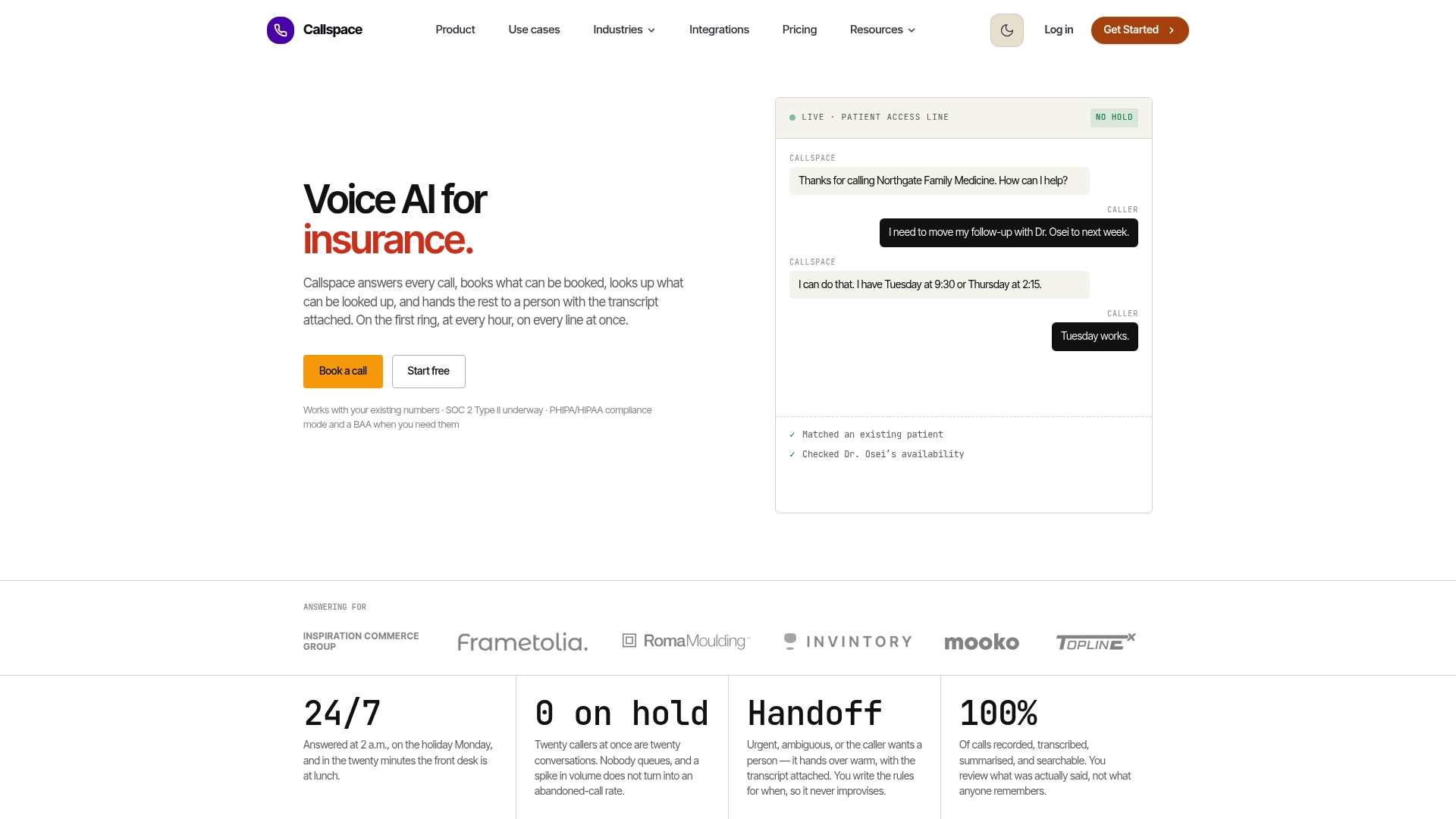
For healthcare, insurance, and ecommerce lines specifically, that handoff matters as much as the automation itself. A caller with a billing question shouldn’t have to explain their situation twice, and context transfer is designed to prevent exactly that. Such platforms also support order lookup through Shopify integrations and calendar syncing for practices juggling appointment volume across multiple providers.
If you’re ready to see how this fits your own call mix, the Basic plan starts at $150 per month, and pricing details for the Team plan are available on the same page. Visit the pricing page to compare plans or start a trial and run your own shadow phase before committing to a full cutover.
Sources
- Voice AI Support 2026: of Calls Automated | Stealth Agents
- AI vs human customer service preference data | Kinsta
- Twohundred
- Shadow mode / parallel-DID testing guidance | DevOps
FAQ
Is an AI Assistant Always Better Than IVR?
Not always. AI assistants handle routine calls, like scheduling and order status, with far less caller effort and higher containment rates than a menu tree. IVR can still make sense for extremely simple, single-decision routing where cost matters more than experience.
How Long Does a Shadow Phase Rollout Take?
Most guidance recommends running the AI assistant in parallel with your existing line for at least two weeks before full cutover. That window lets you catch long-tail call intents and tune the system on real production data instead of guesswork.
Can an AI Voice Assistant Handle Healthcare Calls Safely?
Yes, when the vendor addresses PHIPA and PIPEDA requirements directly, including data residency, encryption, and audit logging. Callspace builds compliance features into its platform specifically for healthcare and insurance call lines.
What Does Callspace Cost?
Callspace’s Basic plan is listed at $150 per month. Pricing for the Team plan is available directly on the pricing page.
Do Customers Actually Prefer Talking to an AI Assistant?
It depends on the call. About 41% of customers prefer AI for simple queries, while roughly 67% want a human once the issue becomes complex or sensitive, which is exactly why warm transfers with full context matter so much.