Claims Status Phone Automation for Insurers: Consent Before Lookup
Learn how insurance call centers can automate claim status calls with identity checks, live system lookups, privacy safeguards, and human handoffs.

Claims status phone automation is an AI phone agent that answers callers asking “what’s my claim status,” looks up the claim through your existing systems, delivers an accurate update, and hands off to a human when the question goes beyond a routine check. For most insurance call centers, this automation fits squarely into the routine status-check volume that drives hold times and abandoned calls. Callspace is one example of a provider built specifically for this kind of regulated, high-volume phone work.
TL;DR:
- Start with one claim type and caller group, test synthetic or sandbox data for at least two weeks, then expand only after accuracy holds steady.
- Tell callers at the start that calls are recorded, explain the purpose, and obtain meaningful consent; voiceprint identification requires express advance consent.
- Use live claims lookups where possible and cache results for only a few minutes when status changes slowly; transfer the transcript and claim context during escalation.
- Track containment alongside status accuracy, successful transfers, time to reach a human, caller satisfaction, failed authentication attempts, and spoofing alerts on a documented review schedule.
Table of Contents
- How an Automated Agent Handles a “What’s My Claim Status” Call
- The Business Case: Containment, CX, and Efficiency
- Rolling Out Claims Status Automation: A Step-by-Step Checklist
- Privacy, Consent, and Security in Claims Status Automation
- Integration Patterns: APIs, Caching, and Warm Transfers
- Measuring Success: The KPIs That Matter
- How We Approach Claims Status Automation in Regulated Environments
- Put Claims Status Automation to Work on Your Lines
- FAQ
- Sources
How an Automated Agent Handles a “What’s My Claim Status” Call
A caller asking about a claim triggers a sequence that needs to happen in seconds, not minutes. The agent first confirms who is calling, usually with a policy number and date of birth, before anything claim-specific gets discussed. Speech recognition then parses the request, distinguishing a status inquiry from other intents like filing a new claim or disputing a denial, so the right workflow fires immediately.

Once the intent is confirmed, the system queries the claims platform or CRM in real time and translates the raw status code into plain language a caller can actually use. If the claim is still processing, the agent says so and offers a callback or an estimated timeline instead of guessing. If the question touches something more sensitive, like a denial reason or a payment dispute, the call moves to a human agent.
A typical flow looks like this:
- Caller states or confirms their identity through policy number and date of birth.
- The agent detects a claim status intent and queries the backend system.
- The claim status gets translated from a database code into a plain sentence.
- Complex or sensitive questions trigger a warm transfer with full context passed along.
- If no agent is available, the system offers a callback and logs the request.
Financial institutions and insurers increasingly treat this kind of voice automation as a core piece of 24/7 call center infrastructure, not an experimental add-on.
The Business Case: Containment, CX, and Efficiency
Routine status checks are exactly the kind of call that automation handles well: predictable questions, structured data, low ambiguity. Handling them without a live agent frees your staff for the calls that actually need judgment, like disputed claims or coverage questions.
The practical gains show up in a few places:
- Containment improves because a large share of status calls never need to reach a queue.
- Average handle time drops since the lookup and response happen instantly, without hold music.
- Abandon rates fall because calls get answered the moment they come in, including nights and weekends.
- Every interaction is recorded and transcribed, giving your QA team a consistent record for training and dispute resolution.
AI voice assistants are already being used for routing, triage, and status-check automation across financial services call centers, reflecting a broader shift toward automated handling of predictable, high-volume inquiries. The appeal isn’t replacing your team: it’s removing the repetitive work that makes staffing a 24/7 line so expensive in the first place.
Rolling Out Claims Status Automation: A Step-by-Step Checklist
A pilot succeeds or fails based on how carefully you scope it before writing a single conversation flow. Rushing integration work or skipping authentication design creates problems that surface weeks later, usually during a live call with a frustrated caller.
- Define scope. Decide which claim types and which caller categories, policyholders, agents, or brokers, the pilot will cover first.
- Map your data sources. Inventory the APIs and systems that hold claim status, and confirm which fields the agent needs to pull in real time.
- Design authentication rules. Set the low-friction identity check for routine lookups and decide when a request escalates to a stronger verification step.
- Build and test conversation flows. Use sandbox or synthetic claim data to run through common phrasings, interruptions, and edge cases before any live calls.
- Launch in phases. Start with a narrow pilot group, expand to partial coverage once accuracy holds steady, then move to full rollout.
Pro Tip: Run your pilot against a sandbox claims environment for at least two weeks before touching live calls; most authentication and intent-detection gaps surface in the first batch of edge cases.
Timelines vary with system complexity, but a focused pilot covering one claim type and one caller group typically takes a few weeks to validate before expanding further.
Privacy, Consent, and Security in Claims Status Automation
Call recording and identity verification put claims status automation squarely inside privacy law, and getting consent wrong creates exposure well beyond a bad customer experience. Organizations should inform customers at the beginning of calls that calls are recorded and specify the purpose, with verbal notice plus keypad confirmation recommended to make that consent meaningful.
Under PIPEDA, organizations must obtain meaningful consent for collection of personal information via automated systems, and biometric voiceprint programs require express, advance consent. Office of the Privacy Commissioner of Canada
A few practices keep a deployment on solid ground:
- State the recording purpose clearly at call start and use recordings only for that stated purpose.
- Avoid voiceprint or biometric identification unless you have express consent and a clear legal basis.
- Layer authentication for sensitive requests: start with policy number and date of birth, escalate to a one-time code or callback when the request touches payment or dispute details.
- Monitor for voice spoofing, since voice cloning materially increases fraud risk in voice systems, and many institutions are adding layered controls as a result.
- Apply risk-based model governance, including a model inventory and a regular review cadence, as OSFI guidance recommends for AI systems in financial services.
Integration Patterns: APIs, Caching, and Warm Transfers
The technical backbone of claims status automation comes down to how reliably the agent can reach your claims data and what happens when it can’t. Real-time API lookups give the most accurate answer, but a short caching window, often just a few minutes, keeps the system responsive during traffic spikes without serving stale data on fast-moving claims.
Mapping backend status codes to plain language matters as much as the lookup itself: a caller doesn’t need to hear “pending adjudication,” they need to hear what that means for their timeline. When a call escalates, the agent should pass the full transcript and claim context to the receiving agent, so the caller never has to repeat themselves.
A short readiness checklist for IT teams:
- Confirm API uptime and latency meet your real-time response targets.
- Set a caching window appropriate to how often claim statuses actually change.
- Build a fallback script for when the claims system is unreachable or the response is ambiguous.
- Test warm transfer payloads to confirm agents receive full context, not just a caller name.
Measuring Success: The KPIs That Matter
Launching claims status automation without a measurement plan makes it impossible to know whether the pilot is working or quietly frustrating callers. A handful of metrics cover both performance and safety.
- Containment rate: the share of status calls resolved without a human agent, tracked against a pilot goal you set before launch.
- Accuracy, measured through regular transcript sampling to confirm status translations match the underlying claim data.
- Transfer success rate and time-to-human, which show whether escalations actually reach an agent with context intact.
- CSAT sampling on automated interactions, collected on a consistent schedule rather than ad hoc.
- Security signals, including failed authentication attempts and spoofing alerts, reviewed as part of the same cadence.
AI adoption in financial services increases model, data governance, and third-party risks, which is why a documented, risk-rated monitoring cadence matters as much as the containment numbers.
How We Approach Claims Status Automation in Regulated Environments
We build for the reality that insurance call centers answer sensitive questions under real regulatory scrutiny. Our platform answers calls instantly, transcribes every interaction, and hands off to a human with full context when a question goes beyond a routine lookup. We support calendar, claims system, and CRM integrations so the handoff between automation and staff stays seamless.
When evaluating any vendor for this work, ask about integration references, authentication controls, and documented escalation workflows before signing anything.
— Sam
Put Claims Status Automation to Work on Your Lines
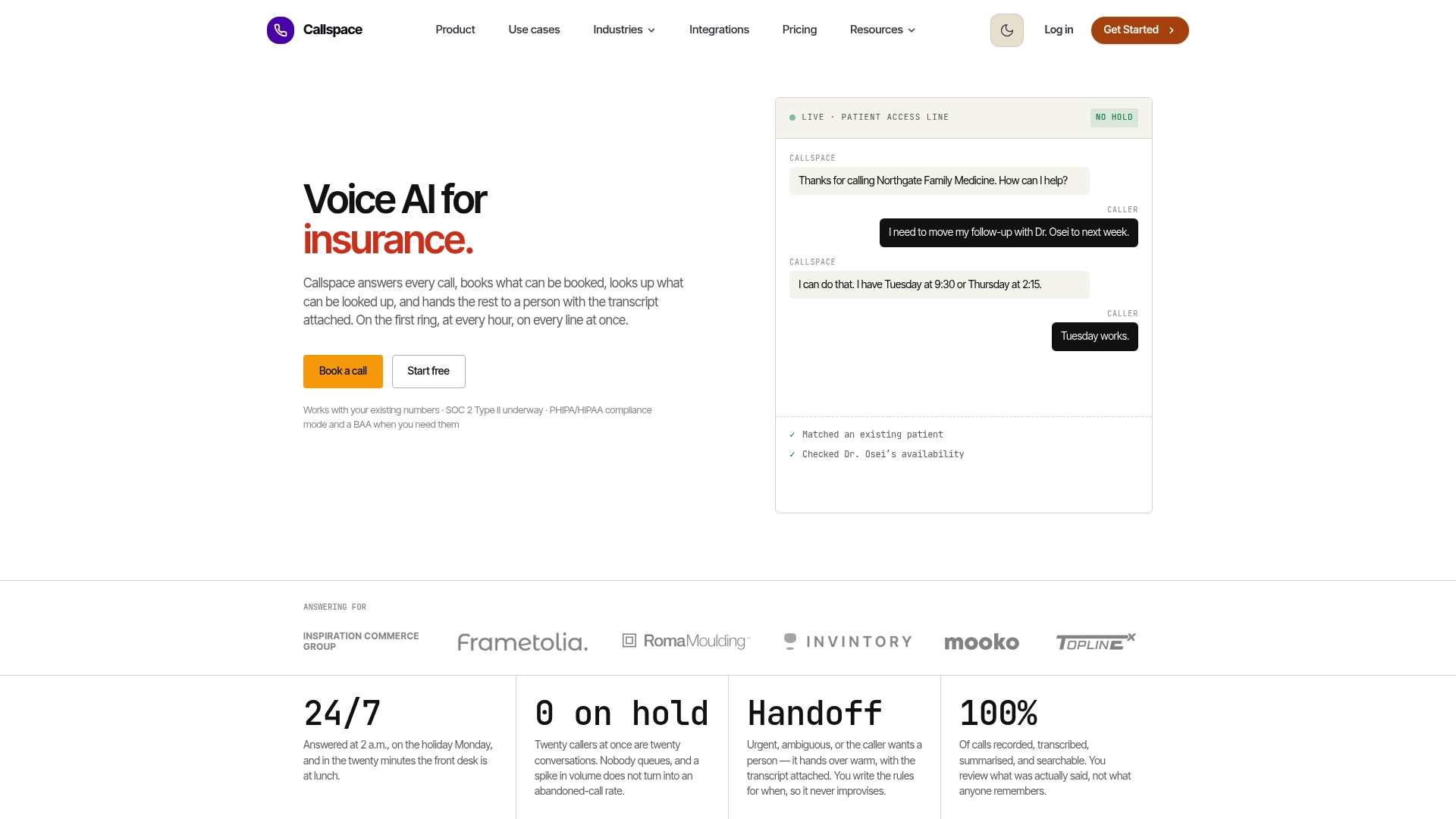
We built our platform to answer common calls insurance teams field most: “what’s my claim status.” Every interaction gets transcribed, sensitive questions get a warm handoff with full context, and integrations connect to the systems you already run.
Next steps:
- Review our Basic and Team plans to see what fits your call volume.
- Explore our insurance industry page for integration specifics.
- Check the product overview for transcription and warm transfer details.
FAQ
What is claims status phone automation?
Claims status phone automation is an AI phone agent that verifies a caller’s identity, looks up their claim in your systems, and gives them a plain-language status update. It handles routine inquiries and transfers more complex or sensitive questions to a human agent with full call context.
How does the system verify who is calling?
Most systems use a low-friction first step, typically a policy number and date of birth, for routine status checks. Requests involving payment details or disputes often escalate to a stronger second factor, such as a one-time code or an agent callback, reflecting layered authentication practices recommended for financial AI systems.
Is call recording for this kind of automation legal?
Recording is generally permitted when organizations inform callers at the start of the call, state the purpose clearly, and obtain consent, often through a verbal notice plus keypad confirmation, as outlined by the Office of the Privacy Commissioner of Canada. Rules on voiceprint or biometric data require separate, express consent.
What does Callspace cost for this kind of deployment?
Current pricing details for our plans are available on our pricing page.
How long does a claims status automation pilot take to launch?
A focused pilot covering one claim type and one caller group typically takes a few weeks to validate before expanding, assuming your claims data and APIs are mapped ahead of time. Timelines extend when integration work or authentication design needs more testing.
Sources
- Artificial intelligence and banking — Financial Consumer Agency of Canada
- Recording of Customer Telephone Calls — Office of the Privacy Commissioner of Canada
- FIFAI II: AI risks and opportunities — OSFI