PIPEDA Safe 90/60/30 Insurance Call Automation for Canadian Insurers
This playbook shows Canadian insurers how to deploy PIPEDA and CRTC compliant automation, run a 90/60/30 renewal flow, and link to AMS/CRM.

Insurance call automation answers routine inbound and renewal calls around the clock, captures full transcripts and consent records for compliance review, and routes anything complex or licensed straight to a qualified human. It cuts missed calls while handling claims intake, renewals, and policy servicing at a volume no front desk team can match on its own. Callspace is one example of a platform built specifically for this kind of regulated, high-stakes call flow.
TL;DR:
- Call automation should seamlessly handle high-volume tasks like renewals, claims intake, and scheduling while securely capturing transcripts for compliance.
- Integration with policy, CRM, and claims systems must support real-time updates and attach transcripts to specific records to ensure auditability.
- Automated calls require clear disclosures, proper consent management, and compliance with privacy laws such as PIPEDA and telemarketing regulations.
- Initial pilots should focus on a limited call type, measure answer rate and accuracy, and establish escalation processes before broad deployment.
- Human agents must handle licensed advice, contested claims, or complex cases, with automation supporting only routine, rule-based workflows.
Table of Contents
- What Insurance Call Automation Actually Does
- How to Automate Renewals With a 90/60/30 Workflow
- Connecting Call Automation to Your AMS, CRM, and Claims Systems
- Compliance, Privacy, and Call Recording Rules You Need to Know
- Rolling Out Call Automation: A Procurement and Pilot Checklist
- What a Vendor Like Callspace Brings to the Table
- When Automation Should Lead and When People Should
- Put Callspace to Work on Your Call Volume
- FAQ
- Sources
What Insurance Call Automation Actually Does
An AI voice agent handling insurance calls needs to do more than play a recorded menu. The strongest systems carry a natural, two-way conversation, detect what the caller actually wants within the first exchange, and accept keypad input when a caller prefers pressing a number over speaking. That combination matters because insurance callers range from a policyholder confirming a mailing address to someone reporting a collision an hour after it happened.
Every call gets transcribed and summarized, then tagged by call type, which feeds two things at once: quality assurance review and dispute resolution when a customer later disputes what they were told. A clean, timestamped transcript is often the only record that settles a disagreement about what was promised on a renewal call.
In practice, these capabilities map onto a handful of recurring insurance workflows:
- Claims intake: capturing incident details, policy number, and initial evidence before a human adjuster ever picks up.
- Renewals and endorsements: confirming details, logging requested changes, and flagging anything that needs underwriting review.
- Billing inquiries: payment status, due dates, and method changes without a hold queue.
- Appointment scheduling: booking or rescheduling calls with agents or adjusters directly against a calendar.
The line that matters most is the warm transfer. The moment a call touches licensed advice, a coverage decision, or a contested claim, the system should hand off to a person, carrying the transcript and summary with it so the policyholder never has to repeat themselves.
How to Automate Renewals With a 90/60/30 Workflow
Renewals are where automation earns its budget line, because the touches are predictable, high-volume, and mostly about confirming information rather than making decisions. A 90/60/30 day schedule gives structure to that outreach:
- At 90 days: an automated call or message confirms the renewal date, invites the policyholder to report any changes, such as a new vehicle or driver, and sets expectations for what happens next.
- At 60 days: a follow-up call captures outstanding changes, validates address and contact details, and logs consent for any requested policy modifications.
- At 30 days: a final call confirms the renewal is ready, flags anything unresolved for a licensed producer, and offers a direct transfer if the policyholder wants to discuss pricing or coverage.
Each touch should capture structured change data, not just a note in a call log. Address changes, new drivers, and vehicle swaps belong in fields the AMS can read directly, each tied to a consent record showing the policyholder actually agreed to the change rather than merely mentioning it in passing.
Where this gets sensitive is re-shopping. Automation can queue a policy for re-shop and record that the customer expressed interest in reviewing alternatives, but the decision to quote new pricing or discuss coverage trade-offs belongs with a licensed producer. The system’s job is to pre-qualify intent and create a clean, auditable trail, not to negotiate terms.
Pro Tip: Run the 90/60/30 schedule on a subset of renewals first and compare conversion against your existing manual process before rolling it out book of business wide.

Connecting Call Automation to Your AMS, CRM, and Claims Systems
Call automation is only as useful as the systems it writes to. Before signing with any vendor, insurers should map exactly where call data needs to land and how fast.
The essential integration targets are:
- AMS or policy management system, so renewal changes and endorsements post directly to the policy record.
- CRM, so sales and retention teams see call history without digging through a separate tool.
- Calendar systems, for scheduling with agents, adjusters, or underwriters.
- Claims intake platforms, so a first notice of loss captured on a call starts the claims file immediately.
- Agent desktop tools, so a transferred call arrives with full context already loaded.
Write-back patterns vary by vendor: some post changes in real time, others batch updates on a delay. Real-time is preferable for anything touching active claims or urgent changes, while batch can be acceptable for lower-priority updates like contact detail confirmations. Every call should attach its transcript and a disposition code to the specific policy or claim record it touched, not just to a generic call log.
Two red flags worth testing for before you sign anything: a vendor that cannot store consent metadata as a structured, retrievable field, and one that cannot attach a transcript to a specific policy or claim record. Either gap turns a routine audit into a scramble.

Compliance, Privacy, and Call Recording Rules You Need to Know
Recording insurance calls is not optional to disclose. Under PIPEDA’s rules on recorded calls, businesses must tell the customer a call is being recorded, state why, and get meaningful consent before recording starts. Consent can be verbal, given through a keypad press, or documented in writing, and it may be implied if the caller continues after being notified.
Regulatory case history backs this up with consequences. A PIPEDA case summary on non-consensual recording shows that failing to give clear notice, or failing to offer an alternative to a caller who objects to being recorded, has led to formal findings and required process changes.
Telemarketing adds a second layer. The CRTC’s Unsolicited Telecommunications Rules require National Do Not Call List registration, restrict automatic dialing announcing devices, set permitted calling hours, and impose record-keeping obligations that apply to insurance outreach. Using a vendor to place these calls does not transfer the compliance obligation away from the insurer.
Operational controls worth demanding from any automation vendor:
- Real-time consent flags attached to every recorded call.
- Documented retention policies for transcripts and consent records.
- Audit logs a compliance team can pull without engineering help.
- A fast, reliable path to a human when a caller objects to being recorded.
FSRA’s guidance on model governance notes that AI and machine learning systems used in insurance need interpretability and explainability controls so automated decisions do not create unfair outcomes for consumers, a standard that extends naturally to call automation feeding underwriting or claims data.
Rolling Out Call Automation: A Procurement and Pilot Checklist
Treat this as a controlled rollout, not a software swap. Before signing a contract, insurers should confirm vendor fit against a short checklist:
- Integration matrix: confirm real-time or near-real-time write-back to your AMS, CRM, calendar, and claims platform.
- Consent capture: verify the vendor stores consent method, timestamp, and caller acknowledgment as structured data.
- Data residency and retention: confirm where transcripts and recordings are stored and for how long.
- SLAs and auditability: get written answer-rate commitments and confirm compliance logs are exportable on demand.
Once a vendor clears that list, a narrow pilot limited to one line of business or one call type (renewals is a common starting point) gives a clean read on performance. FSRA’s operational risk guidance points to narrow pilots with clear KPIs as a way to reduce implementation risk while producing measurable results.
Track answer rate, transcript accuracy, renewal conversion uplift, and compliance audit pass rate during the pilot. Once live, build escalation playbooks for disputed claims, train agents on how handoffs arrive, and keep model governance under ongoing review rather than a one-time sign-off.
Pro Tip: Require your pilot report to include a sample of escalated calls, not just the automated ones, so you can see how handoffs actually perform under real conditions.
What a Vendor Like Callspace Brings to the Table
We provide a platform that answers calls instantly, 24/7, with no hold queue, while capturing full transcripts for every interaction. The platform integrates with calendars and practice management systems, performs warm transfers with context intact, and supports the compliance needs of regulated industries. When evaluating any vendor for insurance call automation, ask for sample transcripts, consent logs, and integration references before committing.
When Automation Should Lead and When People Should
Automation earns its keep on high-volume, low-judgment work: renewal confirmations, basic claims intake, scheduling. Licensed advice, contested claims, and anything touching a coverage decision stay human. Judge success by compliance, retention, and resolution speed, not call volume alone.
— Sam
Put Callspace to Work on Your Call Volume
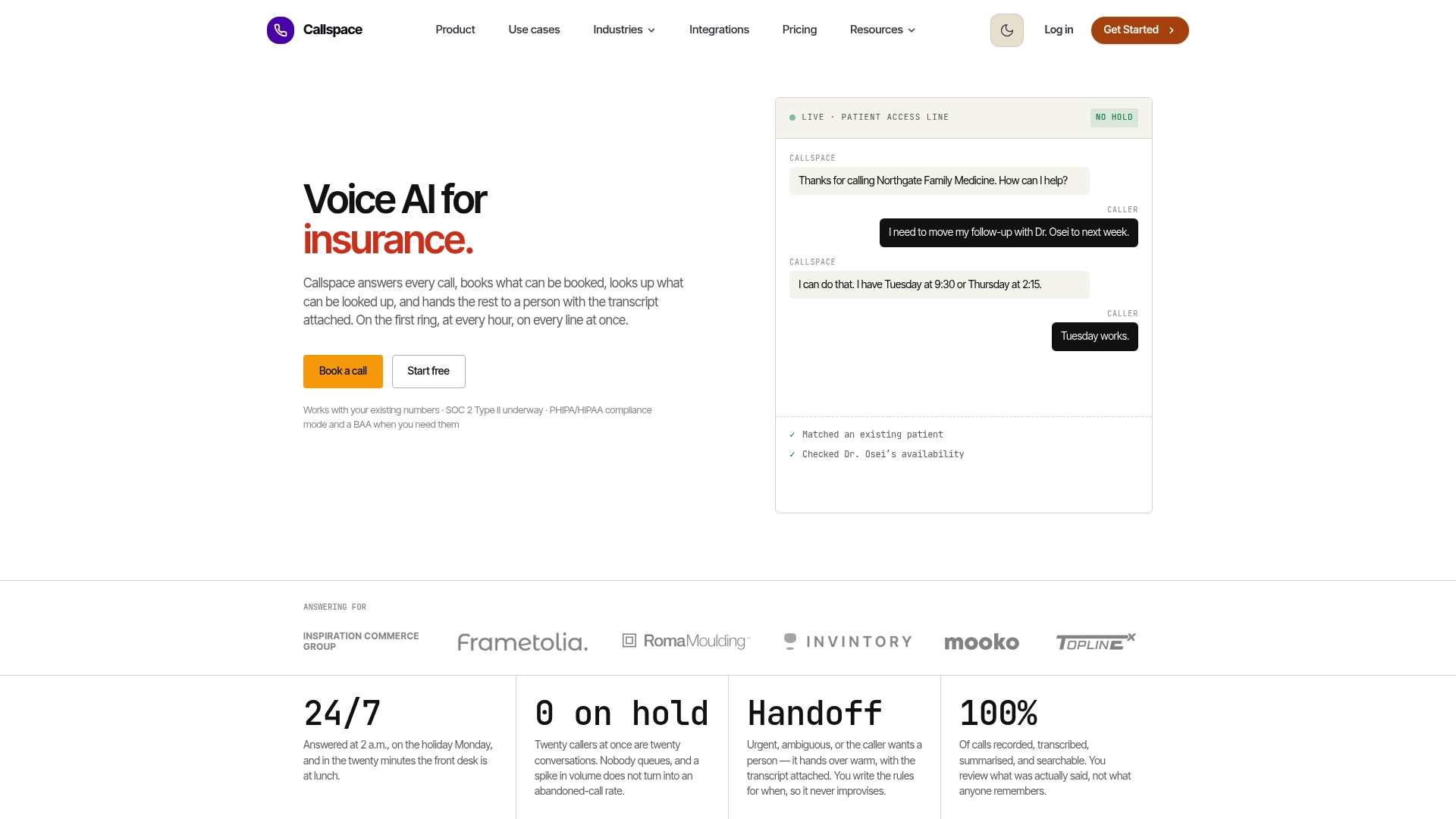
We answer every insurance call the moment it rings, log consent automatically, and hand off anything licensed or complex to your team with the full transcript attached. For insurance agents managing renewal season alone, that means fewer missed calls and a cleaner audit trail without adding headcount.
Our Basic plan runs from a monthly subscription price, and our Team plan is available on request for larger call volumes. Check our pricing page or request a pilot to see how the integration checklist above maps onto your own systems.
This article is general information, not a substitute for advice from a qualified financial advisor. Consult a qualified financial professional about your own circumstances before acting on anything here.
FAQ
What is automation in insurance?
Automation in insurance refers to software handling repetitive tasks such as answering calls, processing renewals, and capturing claims information without a person doing each step manually. It commonly includes AI voice agents, automated underwriting data capture, and straight-through processing for routine policy changes.
Can I automate phone calls?
Yes, platforms built for voice automation can answer calls, hold natural conversations, transcribe and summarize them, and transfer complex calls to a human agent with full context. For insurance specifically, any automated recording must follow PIPEDA’s notice and consent requirements before the call begins.
Is there a free automated call service available?
Most reliable insurance-grade call automation platforms are paid subscriptions rather than free services, since they involve ongoing infrastructure, compliance features, and integration support. Basic plans for AI-powered call automation typically start at a monthly subscription price around this level.
Can AI calling agents be used for insurance companies?
Yes, AI calling agents are used across insurance for renewals, claims intake, and policy servicing, provided they meet recording consent rules and telemarketing requirements such as those set by the CRTC. Licensed advice and coverage decisions should still route to a human agent.
Sources
- Recording of Customer Telephone Calls - Office of the Privacy Commissioner of Canada
- Telemarketing obligations and the Unsolicited Telecommunications Rules - CRTC
- Auto Insurance Data and Analytics Strategy Technical Advisory Committee Report: Fair Treatment of Consumers in Uses of Big Data Analytics in Auto Insurance