How to Shorten Customer Calls Without Causing More Callbacks
Call center managers: cut average call length in a few weeks by fixing the reasons people call most, while keeping repeat calls down.

Most call centers track average handle time (AHT): how long a call takes from hello to the moment the agent finishes their notes. The usual way to lower it is telling agents to talk faster, which backfires: rushed calls leave problems unsolved, and those customers call back. That drags down first-call resolution (FCR), the share of problems solved on the first call.
The approach that lasts is making calls simpler. Find the handful of reasons people call most, fix whatever makes those calls slow, and coach agents on the mistakes that lead to callbacks. SQM Group’s research supports doing it in that order.
TL;DR:
- Making calls simpler lowers handle time faster than asking agents to hurry.
- Split handle time into talk time, hold time and after-call notes. Each one points to a different problem.
- For most centers, 10 to 15 call reasons make up about 80% of calls. Fix those first.
- Putting customer info on one screen, and having calls transcribed automatically, cuts hold time and note-taking.
- Test each change on a small group of agents, and decide in advance what result means keep it or drop it.
Table of Contents
- Quick Changes You Can Make This Month
- Measure Talk Time, Hold Time and Notes Separately
- Find the Few Reasons People Call Most
- Tools That Cut Searching and Note-Taking
- Coach for Accuracy Before Speed
- Remove Holds and Extra Steps From Your Call Process
- Test Changes on a Small Group First
- Recording and Privacy Rules in Canada
- Getting Your Team On Board
- Where Callspace Fits
- Sources
- FAQ
Quick Changes You Can Make This Month
Two or three weeks of small changes usually shows up in the numbers before any larger project would.
- Shorten scripted greetings and sign-offs. A 20-second greeting on 500 calls a day is almost three hours of agent time.
- If a lookup takes under 30 seconds, stay on the line with the caller instead of putting them on hold. For anything longer, transfer them to the right person and explain the issue to that person yourself.
- Give agents a fill-in-the-blanks notes template for your five most common call types, so they aren’t writing notes from scratch after every call.
- When your quality team finds a help article that’s confusing or out of date for one of those five call types, fix it the same day.
Pro Tip: Look at your notes templates before you rewrite scripts. Agents often spend more time formatting notes than talking to the customer, and templates are the easier fix.
Measure Talk Time, Hold Time and Notes Separately
Handle time is three numbers added together: time talking, time with the caller on hold, and time writing notes after the call. Looking at the total hides where the time goes, and each part has a different cause:
- Long holds usually mean agents can’t find information quickly, or don’t have access to the system that has it.
- Long note-taking usually means the notes process or the customer records system is clumsy.
- Long talk time usually points to training or a script that doesn’t fit the call.

Your phone system’s reports and your quality reviews give you the three numbers. Also track repeat calls: the same customer calling back about the same issue within a set window, such as seven days. Tracking repeat calls is how you tell a real improvement from calls that just got shorter.
Decide what you’ll watch before you change anything:
- Main numbers: handle time (as its three parts), first-call resolution, and repeat-call rate.
- Supporting numbers: customer satisfaction scores, cost per call, and whether agents are using the new scripts and templates.
If you only watch handle time, a change can look like a success while callbacks quietly push total call volume up a few weeks later.
Find the Few Reasons People Call Most
For most centers, 10 to 15 call reasons make up roughly 80% of calls, a pattern SQM Group sees across industries. Fixing those reasons in the right order is where most of the savings come from.
- Label every call with its reason when the agent closes it out, and flag customers who call back about the same issue.
- Rank the reasons by volume over the last 60 to 90 days. A few reasons will be far bigger than the rest.
- Pick a fix that matches the cause. Rewrite the script if agents explain something confusingly. Update the help article if the policy answer is out of date. Automate simple lookups like order status, appointment confirmations or basic eligibility checks. Route the call to a specialist straight away if it keeps needing a second transfer.
Fixing a rare call reason barely changes your average, however well you fix it. Fixing a common one shows up within weeks.
Tools That Cut Searching and Note-Taking
Every extra system an agent opens during a call means silence on the line, and another round of notes afterward. SQM ranks simpler agent tools among the most effective software changes a center can make.
When comparing tools, look for:
- One screen with everything on it: customer records, open tickets and account details together, instead of four browser tabs.
- Automatic caller lookup, so the customer’s account opens when the call connects.
- Automatic transcripts and summaries. With Callspace, when a routine call is passed to a person, that person gets the full transcript and a summary. The caller doesn’t have to repeat themselves, and the agent has less to write up afterward.
- A clear line between what’s fully automated and what helps the agent. Full automation (bookings, order lookups, common questions) takes those calls out of the queue. Agent-assist tools make the remaining calls shorter.
Online stores that let callers look up orders through Shopify see the biggest change: a two-minute hold while an agent searches for an order becomes an instant answer.
Coach for Accuracy Before Speed
Telling agents to go faster doesn’t work unless it’s tied to specific call types and what quality reviews found. Industry estimates put about 55% of repeat calls down to agent mistakes rather than customer confusion, so coach accuracy first and speed second.
- Teach agents to give a specific next step. “Someone will follow up” invites a callback.
- Teach short, clear call notes. Long notes take time to write and don’t help the next agent.
- Use quality scores and repeat-call data together to see which agents, and which call types, lead to the most callbacks.
- Run five-minute practice calls on your top three call reasons every week. They stick better than one long monthly training session.
Pro Tip: If two agents handle the same call type and one is 90 seconds faster, check both agents’ repeat-call rates before praising the faster one. A fast wrong answer costs more than a slow right one.
Remove Holds and Extra Steps From Your Call Process
A long call often means a clumsy process. Walk through your most common calls from start to finish and note every point where the agent puts the caller on hold to check another system, get approval, or wait for something to update.
- Wherever an agent has to check another system, connect that system so the information is already on screen.
- Cut routing questions down. If two questions get the caller to the right place, drop the other three.
- Move simple requests like address changes, appointment reminders and status checks to self-service or automated phone answering, so they never reach an agent.
Test Changes on a Small Group First
A good test checks one change at a time. Test five at once and you can’t tell which one helped.
- Write down what you expect. For example: “Updating the help article on billing disputes will cut 45 seconds from those calls without lowering first-call resolution.”
- Split agents into two similar groups. One group gets the change, the other doesn’t. Run it for two to four weeks and compare handle time, first-call resolution, customer satisfaction and cost per call.
- Decide the pass mark in advance: how much faster calls need to get to roll it out, how low first-call resolution can drop before you stop, and how many extra repeat calls would end the test.
Write down what you changed and why before you roll it out. Otherwise, six months later nobody will remember what worked.
Recording and Privacy Rules in Canada
If you record or transcribe calls, tell callers, and follow the Office of the Privacy Commissioner of Canada’s guidance on monitoring for who can access recordings and when to delete them. Keep only the personal information your quality reviews and coaching need.
- Tell callers about recording or transcription at the start of the call, in plain words.
- Limit who can open recordings, encrypt them, and set how long you keep them. Government privacy impact assessments are a useful model for this.
- If the Accessible Canada Act applies to you, write down how you receive and respond to accessibility feedback from customers.
Getting Your Team On Board
The data is the easy part. The harder part is convincing a team that’s been judged on speed for years that solving the problem now matters more. Change how agents are rewarded first, let them help pick which call reasons to fix, and run each test with a clear pass mark. Teams that skip this step go along with the change without believing in it, and it shows in the numbers within a month.
— Sam
Where Callspace Fits
Callspace answers routine calls automatically and passes harder ones to a person along with everything the caller has already said. Every call is transcribed as it happens, so when a booking question or order lookup goes to an agent, they can read what the caller asked instead of starting over. The summary is already written when they pick up, which cuts the note-taking after the call.
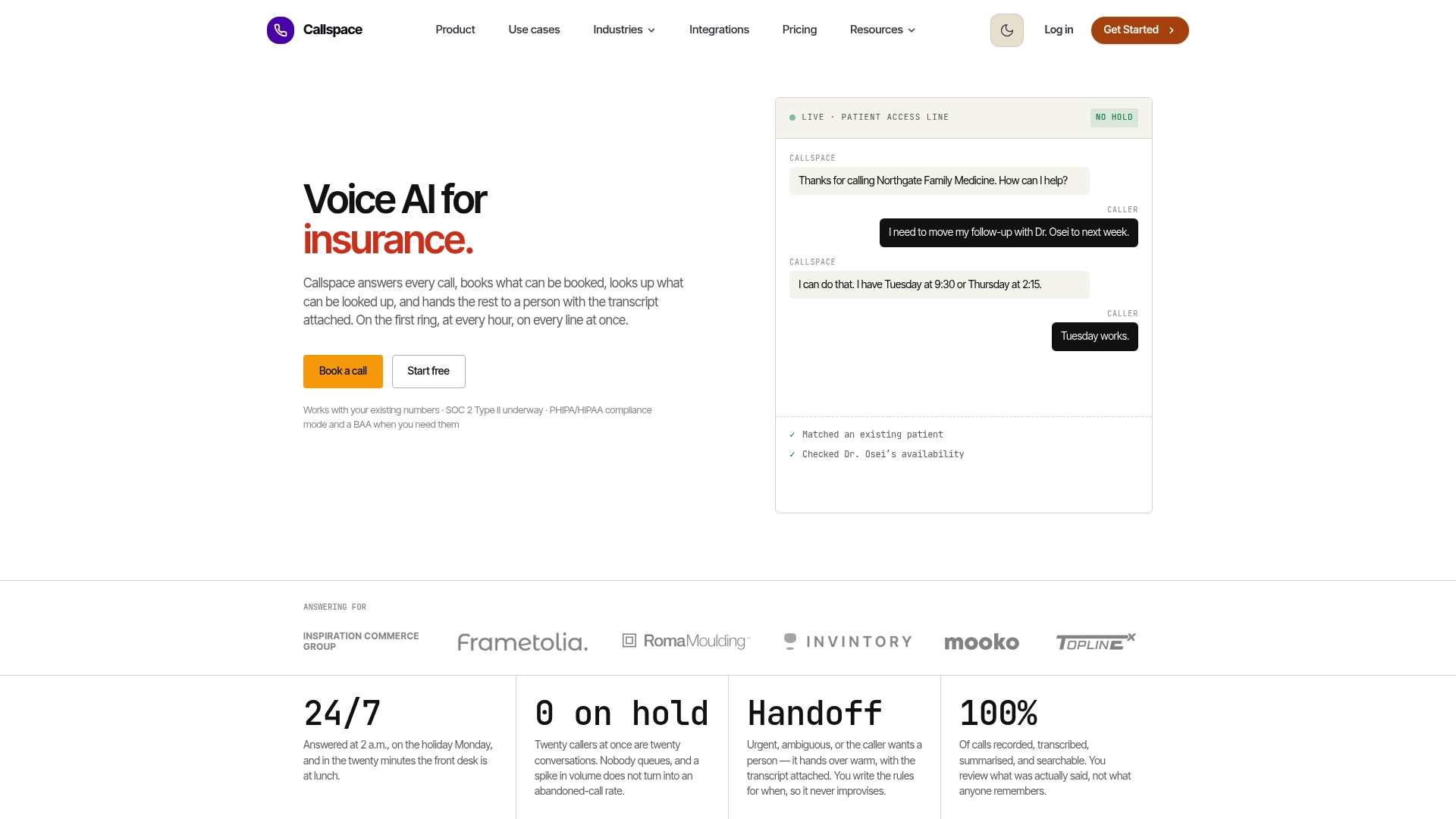
Callspace answers around the clock, connects to calendars, practice management software and online stores for order lookups, and includes compliance features for regulated industries. The Basic plan starts at $150 per month, with a Team plan for higher call volume. See the industries Callspace supports, or go to the pricing page to find the plan that fits your call volume.
Sources
- Surveillance and monitoring of employees — Office of the Privacy Commissioner of Canada
- The Five Fundamentals of a Successful FCR Program
FAQ
What Is a Good Average Handle Time for a Call Center?
There’s no universal target, because call length depends heavily on the industry and how complicated the calls are. Track your own talk, hold and note-taking times alongside first-call resolution instead. If calls get shorter but more customers call back, you haven’t improved.
Does Lowering Handle Time Hurt First-Call Resolution?
It can, if calls get shorter because agents are rushing. SQM Group found that each 1% gain in first-call resolution cuts operating costs by about 1%, which is why fixing the reasons people call pays off more than pushing for speed.
How Does Callspace Help Shorten Calls?
Callspace answers routine calls automatically and passes harder ones to an agent with a transcript already prepared, so agents don’t re-ask questions the caller already answered. It also handles bookings and order lookups itself, which takes those calls out of the agents’ queue.
What’s the Difference Between Talk Time, Hold Time and After-Call Work?
Talk time is the conversation itself. Hold time is any pause while the agent checks something. After-call work is the notes and follow-up tasks once the call ends. Each has different causes and different fixes, so a single average hides where the time goes.
Is It Legal to Record Calls for Coaching in Canada?
Generally yes, for quality and coaching purposes, as long as callers are told and the recordings are stored securely, per the Office of the Privacy Commissioner of Canada’s guidance. Check that your retention and access rules follow that guidance before you start recording or transcribing.