30-30-30 Onboarding Call Flows for Healthcare Teams, BAA and EHR Ready
Healthcare onboarding call flows that enforce BAA and role-based EHR access. Automate 48–72 hour intake and use the 30-30-30 kickoff to cut first-call work.
Onboarding call flows work best when you combine three moves: collect intake before the call, run a short agenda-driven kickoff, and hand the patient or client one quick win with a documented escalation path before you hang up. Do that, and a first call stops feeling like a data-entry task and starts building the trust that carries a relationship through the first ninety days. Skip the prep, and you spend thirty minutes reading a form back to someone who already filled it out.
TL;DR:
- Automating intake, insurance pre-verification, and EHR access prior to the call significantly reduces staff time and streamlines onboarding.
- Using a 20 to 30-minute onboarding script with clear decision-maker and clinical lead participation avoids information overload and improves engagement.
- Sending a secure intake packet 48 to 72 hours before the call and preparing a shared, editable roadmap enhances preparation and client ownership.
- Sending a recap within one hour and booking next steps before hanging up maintains momentum and builds measurable progress.
- Compliance essentials like signed BAA, role-based EHR access, and phase-wise go-live planning are critical before transitioning to active care.
Table of Contents
- What Should You Prepare Before the Onboarding Call?
- How Long Should an Onboarding Call Run?
- What Goes in the Onboarding Call Agenda?
- What Happens After the Onboarding Call Ends?
- What Compliance Steps Come Before Go-Live?
- Why the First Call Should Build Trust, Not Exhaust It
- How Callspace Runs This Playbook for You
- Sources
- FAQ
What Should You Prepare Before the Onboarding Call?
The call itself should never be the first time anyone touches the intake paperwork. Send a secure intake packet, covering demographics, insurance card images, and consent forms, 48 to 72 hours ahead of the scheduled time. That window gives the patient or client room to gather documents without feeling rushed, and it gives your staff a chance to flag anything incomplete before the clock starts running on a booked appointment.
A shared onboarding workspace changes the dynamic further. Instead of a one-way form, give the client a live document with a draft plan and intake fields they can edit alongside your team during the call itself. Practitioner guidance on onboarding tools frames this as co-creation: when someone edits their own plan in real time, they own it in a way a completed PDF never achieves, and hidden scheduling conflicts or coverage gaps tend to surface early instead of on day ten.
Two items belong on your prep checklist before anyone dials in:
- Confirm the compliance layer first. A signed business associate agreement and role-based electronic health record access need to exist before any protected health information changes hands, not after.
- Pre-fill the roadmap. Draft dates, milestones, and default assignments the team can adjust live rather than build from a blank page.
Here’s the sequence that keeps this from turning into busywork:
- Send the intake packet with a clear 48 to 72 hour deadline.
- Open the shared workspace and populate it with a draft roadmap.
- Verify BAA and EHR permissions are active before the call is booked.
- Flag incomplete intake items so the call agenda can address them directly instead of derailing the whole conversation.
Automating intake, insurance pre-verification, and EHR sync ahead of the call delivers the single biggest reduction in staff time during onboarding. That’s the piece worth automating first if you automate nothing else.
How Long Should an Onboarding Call Run?
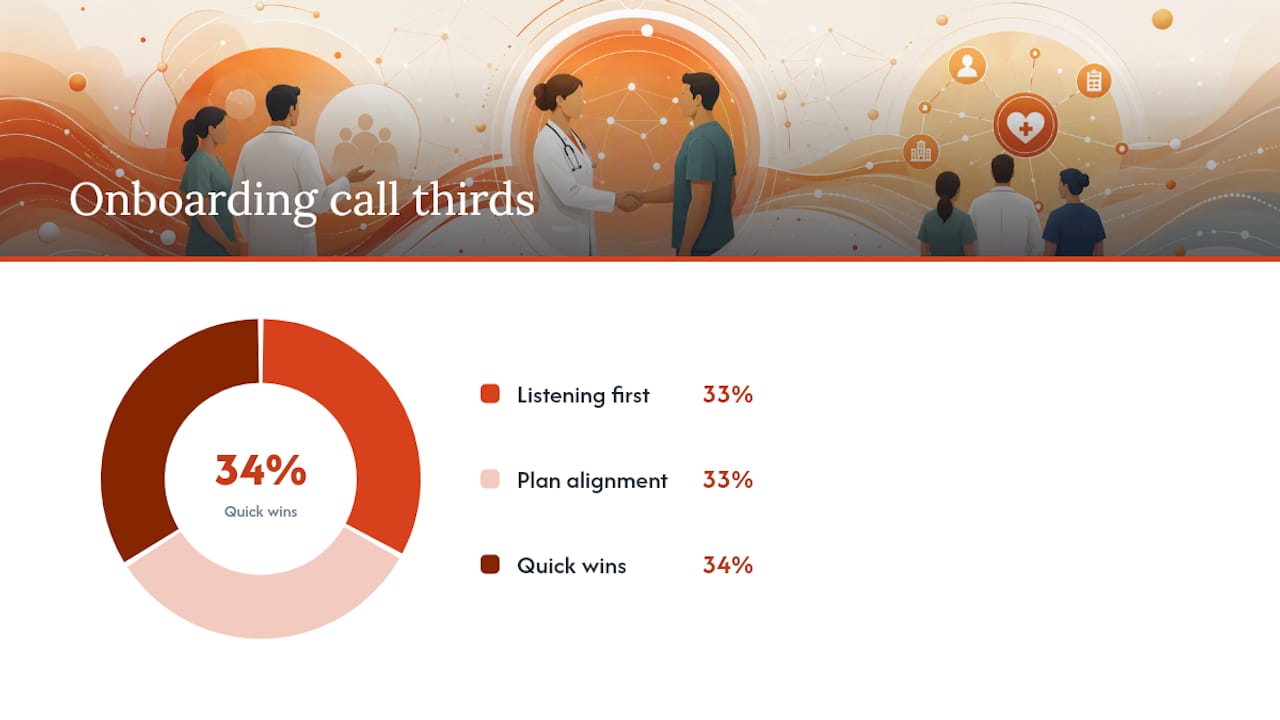
The 30-30-30 model is the simplest structure that consistently avoids information overload: the first third of the call is pure listening, the middle third aligns on the plan, and the final third locks in quick wins. Listening first matters more than it sounds. A patient or office manager who gets to state their goal before you start explaining your process arrives at the alignment phase already invested, rather than being talked at for twenty minutes and asked “does that work for you?” at the end.
When intake is already complete, you don’t need the full structure. OnboardMap’s short-form script runs 20 to 30 minutes and covers confirmation, goal restatement, roadmap walkthrough, and a single assigned action, without the extended listening phase because there’s nothing left to uncover.
Attendance rules matter as much as timing. You want:
- The decision-maker (patient, guardian, or office lead who can approve next steps)
- A clinical lead who can speak to care specifics or scope
- A technical contact if EHR or scheduling integration is part of the onboarding
Leave everyone else off the call. Every additional observer adds a voice that either interrupts the agenda or sits silently and adds nothing. A crowded call is one of the fastest ways to burn thirty minutes without reaching the quick win.
Pro Tip: If more than four people are scheduled to join, split the call. Run a clinical alignment call and a separate technical setup call rather than cramming both into one session that satisfies neither.
What Goes in the Onboarding Call Agenda?
Two templates cover almost every situation you’ll run into. Use the 45 to 60 minute version when intake is incomplete or the case is clinically complex. Use the 20 to 30 minute version when intake is done and you’re mainly confirming alignment.
Both versions run through the same five moves, in the same order:
- Warm open. Skip the small talk about weather and get to a genuine question about what brought them here.
- Restate the goal. Say back what you understand the patient or client wants, in their words where possible.
- Walk the roadmap with dates. Not a vague timeline. Specific dates tied to specific milestones.
- Assign one first step. Not five. One action, owned by one person, due within 48 hours.
- Set the communication rhythm. Tell them exactly how and when they’ll hear from you next.
Winning by Design’s kickoff framework puts it plainly:
The primary goal of a kickoff call is to build trust and validate context, not to execute a procedural handoff. Every minute spent reading a checklist aloud is a minute not spent building the relationship that gets someone through the next ninety days.
For the awkward moments, a short script beats improvisation. If the decision-maker is absent: “I want to make sure the plan reflects what [name] actually needs, can we hold the final sign-off for a five-minute follow-up call once they’ve reviewed it?” If intake is incomplete: “Let’s use today to align on the plan, and I’ll send a short follow-up form for the two items we still need.” If something urgent surfaces mid-call: name the escalation tier out loud, right then, so nobody is guessing who handles it next.
What Happens After the Onboarding Call Ends?
Momentum dies in the gap between the call and the follow-up email. Send a recap within one hour, not the next business day, including the updated shared plan and a link to the recorded call so anyone who missed it can catch up in five minutes instead of scheduling a repeat conversation.
Before you hang up, assign a quick win that finishes within 48 hours. Concrete, fast wins build measurable momentum in a way that a long-term roadmap never does on its own, and book the next check-in on the calendar before the call ends rather than promising to “follow up soon.”
Four metrics tell you whether onboarding is actually working:
- Intake completion rate before the call, not after
- Time-to-first-appointment from initial contact to booked visit
- No-show rate for the first two scheduled appointments
- Escalation incidents logged in the first 30 days
Run a weekly check on these numbers, then a full 30-day performance review to recalibrate scope and escalation paths based on what actually happened, not what the onboarding plan assumed would happen.
What Compliance Steps Come Before Go-Live?
None of this works if the compliance layer is an afterthought. A signed BAA and least-privilege EHR roles need to exist before a single piece of protected health information moves through the call flow, full stop.
Beyond that baseline, four items belong on every go-live checklist:
- Draft an escalation tier map and get physician sign-off on it before the first live call happens.
- Run a test call for every escalation tier, simulating the scenario each tier is meant to handle.
- Go live in phases: start with overflow coverage, then move to primary coverage once staff have calibrated tone and handoff timing.
- Retain recordings and transcripts according to your retention policy, stored securely with access limited to authorized roles.
A role-based access setup built for a healthcare context handles most of this by design rather than as a retrofit.
Why the First Call Should Build Trust, Not Exhaust It
The biggest mistake in onboarding call flows is mistaking thoroughness for care. A team that reads every intake field back to a patient isn’t being diligent, it’s outsourcing its own preparation to the patient’s patience. The calls that actually work front load the paperwork so the live conversation can do what only a live conversation can do: confirm intent, calibrate tone, and hand someone a next step they can complete before they’ve had time to doubt the process.
Most clinics don’t fail onboarding because they lack a checklist. They fail because the checklist replaces the conversation instead of supporting it.
— Sam
How Callspace Runs This Playbook for You
Callspace is built to run the prep-and-handoff half of this playbook automatically, so your team’s live minutes go toward the alignment work that actually needs a human voice. It answers every call instantly, day or night, handles routine scheduling and inquiry volume, and hands off complex cases to your team with a real-time transcript already attached, so nobody re-asks a question the patient just answered.
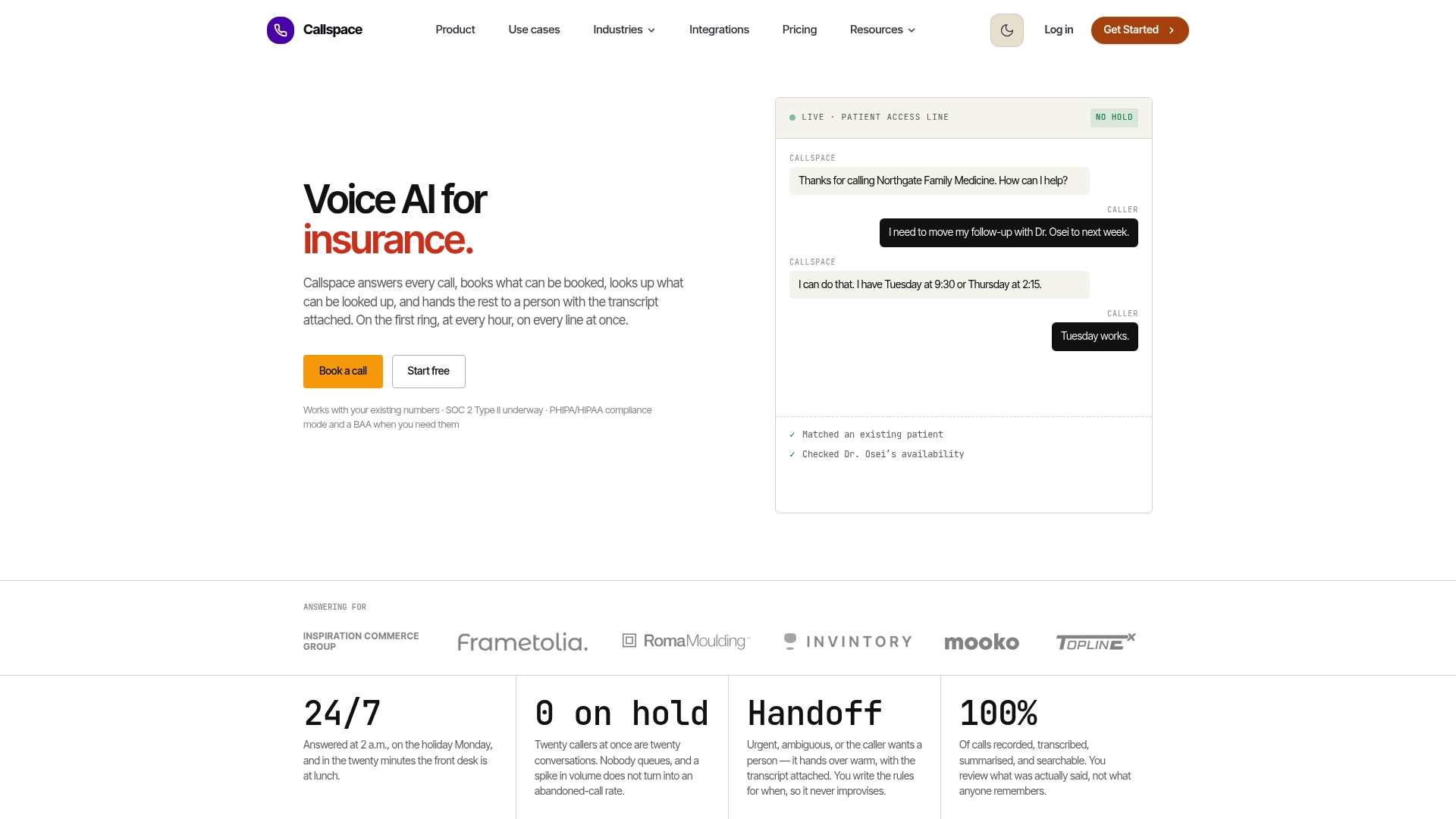
That transcript and context handoff is the piece most call systems skip, and it’s exactly what keeps a 30-30-30 kickoff from turning into a repeat of the intake call. For clinics juggling after-hours volume and staff who can’t be on the phone and in the room at once, Callspace’s healthcare setup covers 24/7 answering, appointment booking, and compliant call handling without adding headcount. Plans start with the Basic tier at $150 per month, with a Team tier available for practices running more complex escalation needs. Check current plan details and start a trial on the Callspace pricing page.
Sources
For teams building out their own call flow documentation, a few sources go deeper than this guide has room for. The Onboarding Lab breaks down kickoff call psychology in more detail, Winning by Design covers trust-building frameworks for client-facing teams generally, and OnboardMap publishes ready-to-adapt call scripts. For teams scaling automated call handling across multiple locations, benchmarked’s work on AI-native operations is worth a look.
This article is general information, not a substitute for advice from a qualified doctor. Consult a qualified healthcare professional about your own circumstances before acting on anything here.
- Conducting a kickoff call (Winning by Design)
- Client onboarding call script: What to say on your first call with a new client | OnboardMap
- Capture client onboarding for medical practices in 2026
- How to onboard a virtual medical receptionist fast
FAQ
What Is the 30-30-30 Call Structure?
It’s a timing model that splits an onboarding call into three equal parts: listening to the patient or client first, aligning on the plan in the middle, and locking in quick wins at the end. The structure comes from The Onboarding Lab’s research on avoiding information overload during first calls.
How Long Should a Patient Onboarding Call Take?
Run 45 to 60 minutes when intake is incomplete or the case is clinically complex, and 20 to 30 minutes when intake is already done and you’re mainly confirming alignment, per OnboardMap’s short-form script. The shorter version skips the extended listening phase because there’s nothing left to uncover.
What Should Be Collected Before the Call, Not During It?
Demographics, insurance information, and consent forms should all arrive through a secure intake packet 48 to 72 hours ahead of the call. Collecting this live during the call is a common mistake that causes overload and eats into the alignment time you actually need.
Does Callspace Handle Onboarding Call Compliance for Healthcare?
Callspace supports healthcare-specific requirements including role-based access and compliant call handling as part of its healthcare offering. Pricing starts at $150 per month for the Basic plan, with Team plan pricing available on request.
What Metrics Show Whether an Onboarding Call Worked?
Track intake completion rate, time-to-first-appointment, no-show rate, and escalation incidents during the first 30 days. Practitioner guidance recommends a formal 30-day review to recalibrate scope and escalation maps once you see how the numbers actually land.