First Call Resolution Rate: How to Measure It and Get Above 80%
How to measure first call resolution: define "resolved", pick one reliable method, fix your biggest low-FCR queue first, and test AI answering on overflow calls.

First call resolution (FCR) is the share of customer contacts a team closes out on the first interaction, with no callback, email, or repeat contact needed. SQM Group’s benchmarking puts a good FCR at 70 to 79 percent and the industry average near 71 percent, and it calls anything above 80 percent “world class”. Each point you gain tends to raise customer satisfaction and lower cost per contact. Callspace helps by answering every call and routing it correctly the first time.
TL;DR:
- To measure FCR, write down what “resolved” means and pick one method. Customer surveys and CRM case tracking are the most reliable.
- FCR varies by call type. General inquiries and account questions usually clear 75 percent; technical support and escalations often fall below it.
- Most low FCR numbers come from how they’re measured, such as agent self-reporting or ignoring customers who switch channels.
- An AI answering service like Callspace catches missed and misrouted calls, especially in busy and after-hours queues.
- Start with your highest-volume, lowest-FCR queue. That’s where a gain moves the most calls.
Table of Contents
- What First Contact Resolution Measures and Why It Matters
- How Do You Calculate First Call Resolution?
- Which Measurement Methods Work Best?
- What Is a Good First Call Resolution Rate?
- Common Mistakes That Distort Your FCR Numbers
- How to Improve First Call Resolution Across Every Queue
- Using AI Answering to Catch Missed Calls
- Three Priorities If You’re Starting From Scratch
- Piloting Callspace to Raise Your First Call Resolution Rate
- Sources
- FAQ
What First Contact Resolution Measures and Why It Matters
Phone-only teams usually say “first call resolution.” Teams that also count chat, email, and social say “first contact resolution.” The difference changes the number: a queue with a strong phone-only FCR can look mediocre once you count the customers who called, then emailed. Decide which one you’re measuring before you compare against any benchmark, including your own from last quarter.
FCR is one of the strongest predictors of customer satisfaction, and it ties directly to cost. A customer who gets their answer the first time doesn’t call back, doesn’t escalate, and doesn’t take up a second agent’s time. That’s why most executive reports put FCR next to CSAT and NPS.
Expected FCR varies a lot by call type, so one target for every queue will mislead you:
- Billing and account questions resolve quickly because the answer usually lives in one system.
- Technical support runs lower because diagnosis takes time and sometimes needs a second touch.
- Complaints and escalations often need follow-up by design, since the fix might involve a refund approval or a manager callback.
With one FCR target across all three, your best team looks mediocre and your understaffed team looks fine.
How Do You Calculate First Call Resolution?
FCR equals the number of contacts resolved on the first interaction, divided by the total number of eligible contacts, multiplied by 100.
For example, if your team handled 4,000 eligible calls last month and 2,900 of them needed no follow-up, your FCR is 2,900 divided by 4,000, or 72.5 percent. That’s in SQM’s “good” band.
The formula is simple. The number it produces depends on three decisions you make first:
- Define “resolved.” Does a customer calling back with a related but different question count against you? Most teams say no, but write the rule down before you start counting.
- Set which calls count. Exclude misdials, calls abandoned before connecting, and internal test calls. Include every call where the customer wanted something resolved.
- Pick a repeat-contact window and keep it. Seven days is common. It catches real unresolved issues without penalizing you for a customer who calls a month later about something new.
Write all three down and share them with everyone who reports the number, from floor supervisors to the executive reading the quarterly report.
Which Measurement Methods Work Best?
There’s no single correct way to measure FCR, and some methods are more trustworthy than others. Pick one based on how precise you need to be and how many surveys your customers will put up with.
Post-call customer surveys are the standard for benchmarking because the customer decides whether the issue got solved. Agents have a reason to log calls as resolved; customers don’t. SQM uses surveys to compare centers across industries, so survey-based FCR is the number other people will trust.
CRM case tracking ties every contact to a case ID and checks whether that case reopens within your window. It’s more accurate than agent self-reporting because nobody has to remember to flag a callback.
AI and rule-based QA models are newer. A well-tuned model can come close to survey-based FCR results, so you can estimate customer-confirmed resolution without surveying every call.
SQM Group puts average industry FCR at about 71 percent. The top quarter of centers clear 80 percent, usually by combining surveys with CRM case tracking.

Contact-reason dashboards give you a daily estimate when you can’t run surveys yet. Tag each contact with a reason code, watch for repeat tags on the same account within your window, and calculate a rough FCR every day instead of waiting for monthly survey results. It’s less reliable than a survey, and it’s a reasonable fallback when too few customers answer your surveys.
Most larger teams run two methods side by side: a survey for the number that goes to leadership, and a dashboard that supervisors and agents check every day.
What Is a Good First Call Resolution Rate?
Compare each queue against its own call type, since a single company-wide average hides the differences.
SQM’s research by industry shows general inquiries and account maintenance calls post higher FCR than technical support or complaints, because the fix is usually a lookup instead of a diagnosis. A general inquiry queue below 75 percent probably has a problem. A technical support queue at the same number might be doing well.
Raising FCR pays off in CSAT, NPS, and cost. Every call resolved the first time means one fewer callback, one fewer escalation, and one fewer agent-hour spent getting caught up on a customer’s history.
Common Mistakes That Distort Your FCR Numbers
Most low FCR numbers come from how the metric is measured, and the same mistakes show up across companies:
- Never defining “resolved.” Without a written standard, every agent and supervisor makes their own call, and FCR ends up measuring how optimistic your team is.
- Relying on agent self-logging. Agents mark cases resolved because that’s the expected outcome of a call, whether or not the customer’s issue is closed. Self-logging and raw repeat-contact counts both skew the numbers compared to CRM or survey data.
- Treating repeat contact rate as FCR. The two are related. A drop in repeat contacts can also mean customers gave up.
- Missing customers who switch channels. A customer who calls, gets frustrated, and emails instead won’t show up as a repeat phone contact, even though the call resolved nothing.
- Never comparing internal and customer-reported numbers. If your CRM says 78 percent and your survey says 68 percent, the ten-point gap points at your definition of “resolved.”
Tip: Track CRM-based FCR and survey-based FCR side by side for a full quarter before you choose your official number. The gap between them usually shows where your definition is off.
How to Improve First Call Resolution Across Every Queue
FCR usually improves through five or six smaller changes, applied first to the queues where they’ll help most.
-
Fix the knowledge base first. If the right answer takes four clicks and two tab switches to find, agents will guess or transfer. A searchable, up-to-date knowledge base is the most effective change most centers can make, and it costs less than retraining everyone. A tool like the Referral Quality Scorecard can help.
-
Retrain on the calls that fail. Pull a sample of your lowest-FCR calls and look for the pattern: a product knowledge gap, a misunderstood policy, or a habit of transferring too early. Coaching aimed at a specific pattern works better than a general refresher course.
-
Fix IVR routing so fewer calls land in the wrong queue. A caller who reaches the wrong queue and gets transferred is starting over, and the transfer often counts against your FCR even when the second agent solves it right away. List your top ten call reasons and make sure your IVR options use the words customers use.
-
Pass full context on every transfer. Some calls need a specialist. When they do, make sure the receiving agent gets the full context immediately so the customer doesn’t have to explain everything again. That alone tends to raise FCR, because “I already told the last person this” is a common reason customers call back.
-
Give agents tools that show answers during the call. Prompts that pull up relevant knowledge base articles or account history as the customer talks cut the time agents spend searching, and less searching means fewer “let me call you back” endings.
-
Test changes on one queue before rolling them out. Apply the change to one queue, measure FCR and CSAT for four to six weeks, and compare against a similar queue that didn’t get the change. That’s how you tell whether the knowledge base rewrite worked or the improvement was seasonal.
Tip: Start with the queue that has the most volume and the lowest FCR. A five-point gain on your biggest queue affects more calls than a fifteen-point gain on a small specialty line.
Using AI Answering to Catch Missed Calls
Many FCR failures never show up in your numbers because nobody answered the call. A missed call that goes to voicemail and gets a callback three hours later is a failed first contact. An AI answering service like Callspace fixes that before coaching comes into it.

Callspace answers every call immediately, so callers don’t hang up in a queue. For routine requests like booking appointments, looking up orders, or answering common questions, it resolves the call itself. For anything that needs a person, it transfers the call with a live transcript, so the agent doesn’t ask the customer to repeat themselves.
To test it without disrupting your whole operation:
- Start with your overflow or after-hours queue, where missed calls cost you the most FCR.
- Measure FCR and CSAT for that queue for a few weeks before you turn it on.
- Measure again afterward with the same method, so the before-and-after comparison holds up.
A pilot like this shows quickly whether AI answering resolves more calls or just moves the problem somewhere else.
Three Priorities If You’re Starting From Scratch
Do these in order: write down your definition of “resolved” and your repeat-contact window before you measure anything, pick one measurement method as your official number, and work on your highest-volume, lowest-FCR queue first instead of chasing an average across every line.
For your next leadership meeting, bring five things: your written definition of “resolved”, your time window, your measurement method, current FCR by queue, and the one queue you’ll improve this quarter.
Piloting Callspace to Raise Your First Call Resolution Rate
Most FCR programs never count the calls nobody answered. Every missed call, after-hours voicemail, and misrouted transfer is a failed first contact that doesn’t appear in your numbers, and coaching can’t fix a call nobody picked up.
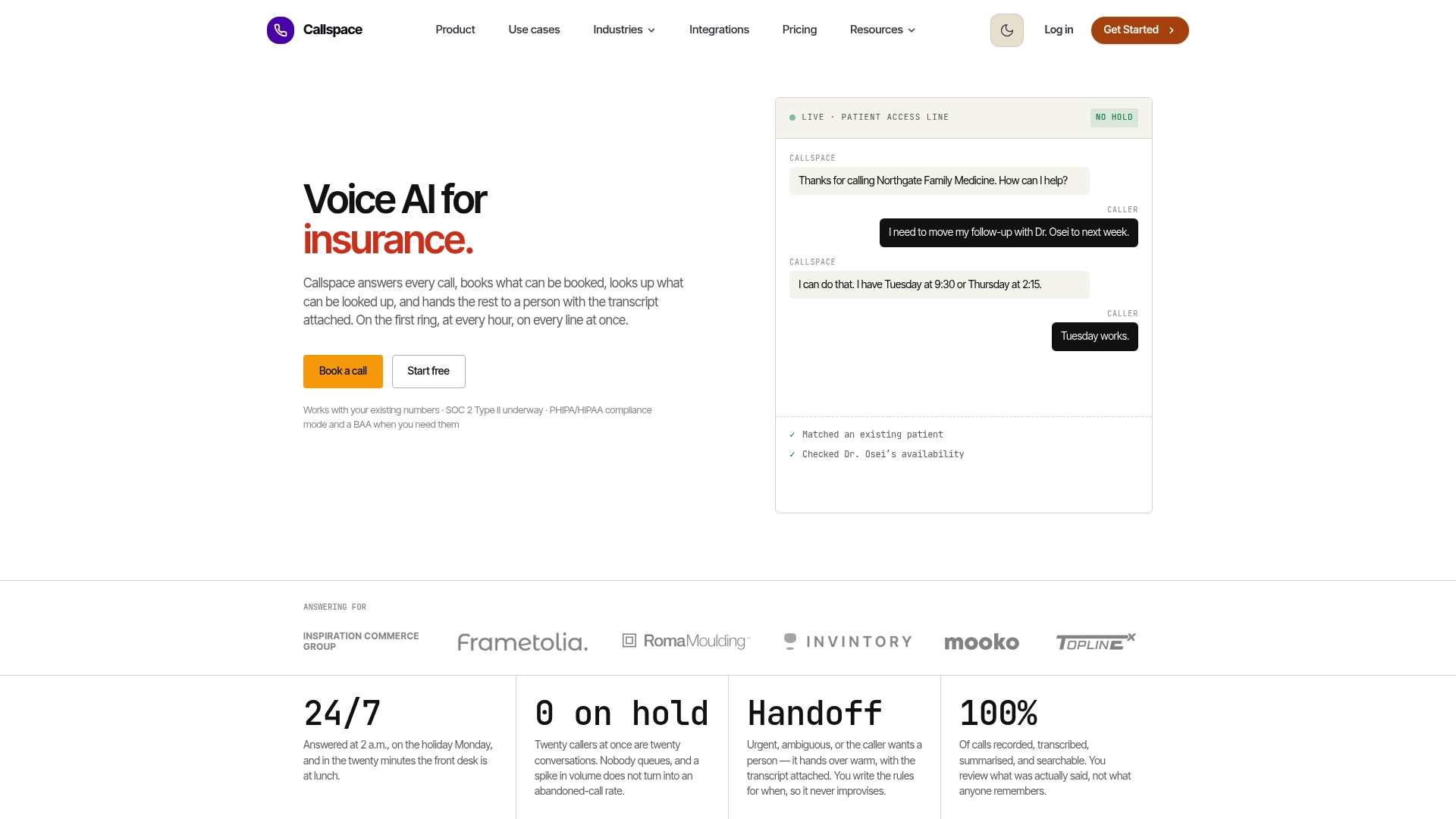
Start with a small pilot. Put Callspace on your overflow or after-hours line first, where the most calls go unanswered and a change is least disruptive. It answers immediately, handles routine requests like booking and order lookups on its own, and transfers complex calls to your team with a full transcript, so agents know what the customer needs before they say hello. Healthcare clinics, insurance teams, and e-commerce support lines already run this setup; see how it works for your industry.
The Basic plan is $150 per month, and a Team plan for larger operations is priced on request. To compare Callspace with other answering services, see the comparison page, then pick a pilot queue and start tracking FCR before and after.
Sources
- What good first call resolution rate — SQM Group
- The Difference Between Measuring Repeat Contacts and First Contact Resolution — CallCentreHelper
- First call resolution — Wikipedia
FAQ
What Is a Good First Call Resolution Rate?
SQM Group’s benchmarking puts a good FCR between 70 and 79 percent. It calls anything above 80 percent world class, and the industry average is about 71 percent.
How Do You Calculate First Call Resolution?
Divide the number of contacts resolved on the first interaction by the total number of eligible contacts, then multiply by 100. For example, 2,900 resolved calls out of 4,000 eligible calls is an FCR of 72.5 percent, assuming you’ve defined “resolved” and your repeat-contact window beforehand.
What Is the 80/20 Rule in Call Centers?
There’s no single “80/20 rule” for FCR; call centers use the phrase loosely for different targets. If you’ve heard it applied to resolution rates, it most likely refers to the 80 percent mark SQM uses for top-performing centers.
What Is FCR (First Call Resolution)?
FCR is the percentage of customer contacts resolved on the first interaction, with no callback or follow-up needed. It’s one of the strongest predictors of customer satisfaction and drives contact center cost, which is why most customer service teams track it alongside CSAT and NPS. Callspace helps by cutting missed and misrouted calls, two common causes of low FCR.