Test in 2–4 Weeks: Phone Conversational AI That Meets Canadian Privacy
Find phone conversational AI that pairs under one second response with Canadian privacy. Run a 2–4 week pilot to measure latency, transcript accuracy, and...

For most businesses, a managed low-latency phone voice AI platform beats building an owned stack, mainly because caller experience lives or dies on latency and endpointing that take specialist teams years to tune. The exception is high-volume operations with strict data control needs, where an owned stack earns its complexity. Either way, the next move is the same: run a short, instrumented pilot before signing anything longer than a month.
TL;DR:
- Latency, specifically a response time below 800 milliseconds for 90th percentile reactions, is vital to prevent callers from disengaging.
- Endpoint detection accuracy affects whether the system interrupts or leaves long pauses, impacting caller experience.
- Full integration with business systems like CRM, EHR, or ecommerce platforms is essential for effective automation and real-time data access.
- Data privacy and consent protocols must be strictly followed, including clear recording notices, secure storage, and compliance with health privacy rules.
- A short, two- to four-week pilot measuring key metrics such as response speed, transcript accuracy, and transfer success is critical before full deployment.
Table of Contents
- What conversational AI for phones actually does
- How the phone AI pipeline turns speech into action
- The technical trade-offs that decide whether callers hang up
- Privacy, consent, and the rules that shape how you configure it
- Choosing a vendor: the checklist that separates a good pilot from a wasted quarter
- Where Callspace fits against this checklist
- What actually breaks pilots
- Try Callspace before you commit to a longer contract
- Sources
- FAQ
What conversational AI for phones actually does
Conversational AI for phones is software that answers, understands, and responds to live phone calls in real time, using streaming audio rather than typed text. It listens as the caller speaks, transcribes continuously, decides when the caller has finished a thought, and generates a spoken reply fast enough that the exchange feels like a normal conversation rather than a walkie-talkie exchange with lag.
That real-time constraint is what separates it from a chatbot or a smartphone voice assistant. A chatbot can take a few seconds to think because the reader is scanning text, not waiting on a live line. A voice assistant like the ones built into phones handles short commands and lookups, not extended, multi-turn business conversations with scheduling logic, account lookups, or handoff rules. Phone voice AI also carries a heavier regulatory footprint, since it usually records and stores conversations that include personal or health information.
In practice, businesses deploy phone conversational AI for a narrow set of jobs:
- Answering every incoming call instantly, including overflow and after-hours volume that would otherwise go to voicemail.
- Booking, rescheduling, or canceling appointments by connecting to a calendar or practice management system.
- Qualifying leads or routing calls to the right department or person based on intent.
- Resolving routine requests such as order status, hours, or pricing without a human agent.
- Handling the first few minutes of a complex call, then transferring to a human agent with full context intact.
The common thread is that the caller never knows they hit a queue. Whether that job goes to a managed platform or an in-house build depends on how the underlying pipeline is assembled, which is where the technical differences actually show up.
How the phone AI pipeline turns speech into action
Every phone voice AI system, regardless of vendor, is built from the same core stages, and understanding them helps you ask sharper procurement questions instead of taking a sales pitch at face value.
- Streaming automatic speech recognition (ASR) converts the caller’s audio into text as they talk, word by word, rather than waiting for a pause. This stage also handles endpoint detection, deciding the moment the caller has stopped speaking so the system knows when to respond.
- Natural language understanding and orchestration, usually a large language model, interprets what the caller wants, pulls in relevant context (account history, prior turns, retrieved documents), and decides the next action or reply. Retrieval-augmented approaches let the model pull real business data, like appointment slots or order records, instead of guessing.
- Text-to-speech (TTS) synthesis turns the generated reply back into audio, and the voice persona, pacing, and tone are usually configurable here.
- Telephony infrastructure carries the actual call: Media Streams-style connections, SIP trunks, CPaaS providers, or direct PSTN connectors move audio between the caller and the AI system, while webhooks and APIs trigger actions like booking a slot or logging a transcript.
Integration depth is what turns a voice pipeline into a business tool. The system needs to talk to a CRM or EHR to know who is calling and why, a calendar to book real appointments, and in ecommerce settings, a platform like Shopify to look up order status without a human touching the phone.
Pro Tip: Ask any vendor to draw their pipeline on a whiteboard call. If they can’t clearly separate ASR, orchestration, and TTS, they likely can’t tell you where latency is coming from either.
The technical trade-offs that decide whether callers hang up
Latency is the single biggest determinant of whether a phone AI feels natural or broken, and it is measurable well before you sign a contract. Time-to-first-token, the gap between when the caller stops talking and when the system starts responding, is the metric to press vendors on. Practitioners are advised to measure TTFT at the 90th percentile during pilots, targeting a sub-800ms median while keeping the 90th percentile under roughly one second to avoid caller disengagement.
Independent measurements of GenAI calling apps found many exceed one second in time-to-first-token, which research on human-to-GenAI calling ties directly to architecture and hosting choices rather than model quality alone. A system hosted far from the caller, or one that routes through multiple unnecessary hops, will feel sluggish no matter how good its language model is.
Beyond raw speed, endpoint detection determines whether the AI interrupts callers mid-sentence or leaves long, awkward pauses. Endpointing methods that combine end-of-word tokens with encoder-based voice activity detection meaningfully cut interruption errors and latency-related user experience problems in streaming ASR systems. This is also what governs “barge-in” handling, the ability for a caller to interrupt the AI mid-response, which matters enormously when someone needs to correct a misheard detail.
A few practical factors worth weighing before you pilot:
- Model topology matters: audio-direct multimodal models can skip a translation step and cut latency, while a text-based ASR-LLM-TTS chain is often easier to audit and control but adds handoff delay at each stage.
- Geographic hosting of the inference infrastructure affects round-trip time; a model running on the other side of the continent from your call traffic adds latency you cannot tune away.
- Inference fallbacks should exist for when a model times out or errors, so the caller gets a graceful human handoff instead of dead air.
- Ongoing monitoring of latency, error rates, and endpointing accuracy needs to be a standing practice, not a one-time pilot check.
Privacy, consent, and the rules that shape how you configure it
Recording and transcribing phone calls triggers privacy obligations before a single feature gets built. Under Canadian federal privacy law, organizations must give callers meaningful notice and obtain consent before recording, and the Office of the Privacy Commissioner’s guidance on call recording recommends multiple touchpoints, such as an audible notice at the start of the call, keypad confirmations, and mentions on billing statements, rather than relying on a single disclosure buried in fine print.

Healthcare adds another layer. Provincial health privacy rules require custodians to obtain express, knowledgeable consent for recordings that capture biometric or health information, along with strict retention and destruction controls, according to guidance on AI and health-sector privacy from Ontario’s Information and Privacy Commissioner. A dental or medical clinic deploying voice AI needs to confirm the vendor’s consent flow and retention policy match these obligations, not just assume a generic terms-of-service checkbox covers it.
Before signing with any vendor, ask for concrete answers on these points:
- Where audio and transcripts are stored, and whether data residency options exist for regulated clients.
- Whether personal identifiers or biometric voice data can be redacted from stored transcripts.
- What the retention period is by default, and how deletion requests are processed.
- Whether a human can review flagged calls, and what the audit trail looks like if a dispute arises.
- How the vendor responds to a data breach involving call recordings.
Pro Tip: Treat voice AI as an operating system component that needs monitoring and retraining signals, not a “set-and-forget” tool, in line with the Government of Canada’s guidance for AI system managers, which recommends ongoing risk assessment rather than a one-time launch check.
Choosing a vendor: the checklist that separates a good pilot from a wasted quarter
Evaluating conversational AI for phones comes down to six measurable criteria, and every one of them should be testable in a pilot before you commit to a longer contract.
- Latency at the 90th percentile, not just the average, since a handful of slow responses is what callers remember.
- Endpointing accuracy, measured by how often the system cuts off a caller or leaves an unnatural pause.
- Handoff fidelity, meaning whether a human agent receiving a transferred call gets a full, accurate transcript and context, or has to start over.
- Integration depth, covering how cleanly the system connects to your calendar, EHR, CRM, or ecommerce platform.
- Data governance, including residency, redaction, retention, and deletion workflows.
- Support and SLA terms, since a phone line going down during business hours is a different emergency than a chatbot glitch.
During procurement, press vendors on specifics: where is audio processed, who internally can access transcripts, what is the deletion workflow, and is call data ever used to train models beyond your own account. Vague answers to any of these are a red flag, as are pricing models that charge per minute with no cap or per seat regardless of call volume.
A short pilot, typically two to four weeks, should collect concrete numbers rather than impressions.
| Metric | What to track | Why it matters |
|---|---|---|
| Time-to-first-token (90th percentile) | Response delay after caller stops speaking | Predicts perceived naturalness and hang-up risk |
| Call resolution rate | Share of calls completed without human help | Shows real automation value versus marketing claims |
| Abandonment rate | Callers who hang up before resolution | Flags latency or script problems early |
| Transcript accuracy | Manual spot-check against recordings | Confirms ASR quality for your industry’s vocabulary |
| Warm-transfer success | Whether human agents get full context | Tests handoff fidelity under real conditions |
Where Callspace fits against this checklist
Callspace is built around the same job this checklist describes: answering every call instantly, handling routine and urgent requests, and handing off complex ones to a human agent with a full transcript attached. It targets the criteria that matter most for regulated and appointment-driven businesses.
- Real-time transcription and context transfer, so a human picking up a warm transfer sees what already happened on the call.
- Calendar and practice management integrations for booking and rescheduling without a staff member on the line.
- Shopify integration for ecommerce order lookups and status checks.
- Compliance features built for healthcare and insurance environments, where consent and retention rules are strict.
- 24/7 availability, covering after-hours and overflow volume that would otherwise hit voicemail.
A sensible pilot design mirrors the checklist above: track time-to-first-token, transcript accuracy on your own call types, and warm-transfer success over two to four weeks across a sample of real call volume, comparing it against your current abandonment rate. Callspace’s own industry pages outline the specific call types clinics, insurers, and ecommerce teams tend to automate first.
What actually breaks pilots
If there is one lesson worth repeating, it is this: latency and consent design decide whether a phone AI pilot succeeds, far more than which language model sits underneath it. Two mistakes show up constantly. Teams underweight endpointing until callers start complaining about being cut off mid-sentence, and they under-specify data deletion until a compliance review stalls the whole rollout. Run a short, instrumented pilot with real call volume before committing further, and measure both.
— Sam
Try Callspace before you commit to a longer contract
Callspace offers two plans built for exactly this kind of evaluation. The Basic plan runs $150 per month and suits smaller practices or single-location businesses testing call automation for the first time, while the Team plan, priced on request, fits multi-location or higher-volume operations needing broader coverage.
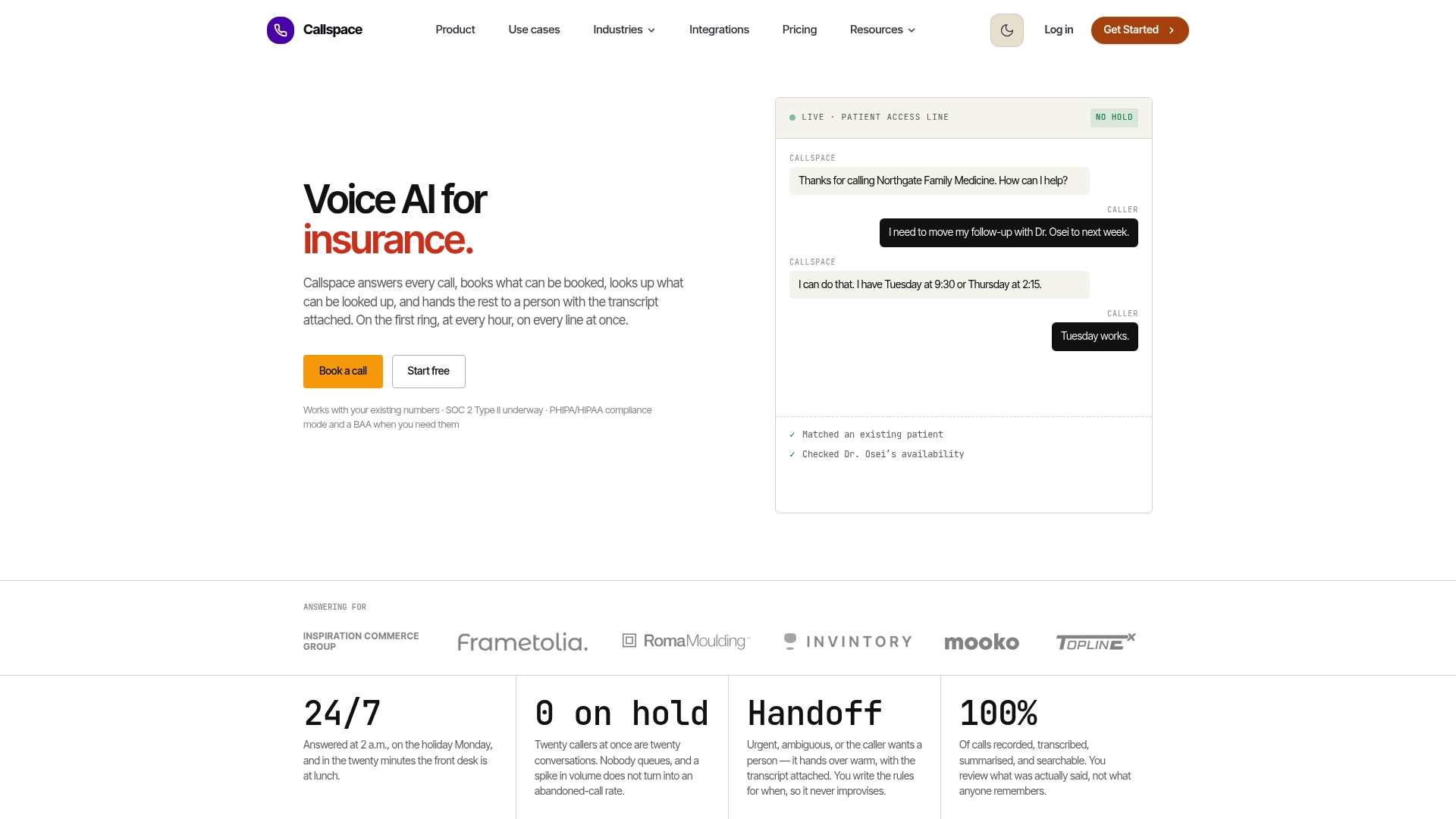
During a trial, track the same numbers this guide covers: response speed, transcript accuracy on your own call types, and how often a warm transfer actually saves a caller from repeating themselves.
- Compare plans and start a trial on the Callspace pricing page.
- Review industry-specific examples to see how similar businesses automate their first calls.
Sources
- Recording of Customer Telephone Calls - Office of the Privacy Commissioner of Canada
- Improving endpoint detection in end-to-end streaming ASR for conversational speech | alphaXiv
- Hello, GenAI? Dissecting Human-to-Generative-AI Calling (IMC 2025)
FAQ
How to have a conversation with AI on your phone?
Most phone conversational AI runs through a regular call, either inbound to a business line or through an app that connects you to a voice agent; you simply speak naturally and the system responds in real time. No special setup is needed on the caller’s end since the AI handles ASR, understanding, and speech generation on the business side of the line.
What is the best conversational AI app for phones?
There is no single best app since the right choice depends on call volume, industry, and whether you need healthcare-grade compliance or ecommerce integrations like Shopify. Businesses evaluating options should compare latency performance, integration depth, and data governance rather than picking by name recognition alone.
What AI can I talk to like a phone call?
Many businesses now deploy AI voice agents, like Callspace, that answer incoming calls, handle bookings and routine questions, and transfer complex issues to a human agent with full context. These systems are designed to sound and respond like a live conversation rather than a scripted menu.
What is the best AI for phones for businesses?
For businesses automating inbound calls, the strongest fit depends on your industry’s compliance needs and existing systems, such as a calendar or CRM, that the AI needs to connect to. Callspace, for instance, focuses on healthcare, insurance, and ecommerce use cases with real-time transcription, warm transfers, and Shopify and calendar integrations built in.