24/7 AI First Chiropractic Phone Answering With Human Escalation
Clinic guide to AI first phone answering with human escalation. 24/7 pickup, HIPAA and PHIPA safeguards, and calendar integrations to protect privacy and...

Use an AI-assisted answering service with human escalation to capture new patients and keep clinicians focused on care. This approach answers every call instantly, books and reschedules appointments without tying up front-desk staff, and routes anything urgent or unclear to a real person. Callspace builds this kind of coverage specifically for healthcare practices, including chiropractic clinics.
TL;DR:
- Most AI-assisted answering services for chiropractors handle routine inquiries, appointment booking, and after-hours coverage while routing complex calls to staff within seconds.
- Integration with existing practice management systems is crucial to avoid double work and ensure seamless, real-time updates for scheduling and patient information.
- Privacy compliance requires encryption, access controls, and clear data storage policies, with a strong emphasis on verifying caller identity and avoiding clinical details in voicemails.
- Hybrid models, combining AI and live receptionists, are generally the most cost-effective and operationally aligned with the limited clinician hands-on time in chiropractic practices.
- Response quality and escalation speed during trial runs reveal more about a vendor’s reliability than sales claims, making testing critical before long-term commitments.
Table of Contents
- What chiropractic phone answering services actually cover
- Live receptionists, AI-first, and hybrid models compared
- Privacy and compliance clinics must verify before outsourcing calls
- Pricing and billing shapes to expect from answering services
- How to choose a vendor and the red flags that signal trouble
- Why hybrid answering fits how chiropractic practices actually run
- Callspace: a practical fit for chiropractic phone coverage
- Sources
- FAQ
What chiropractic phone answering services actually cover
A phone answering service for a chiropractic clinic handles the repetitive, high-volume parts of the front desk so your staff can focus on patients already in the building. The scope is wide, but it is not infinite, and knowing the boundary matters as much as knowing the capabilities.
Most services, whether staffed by people or run on AI, handle:
- New-patient intake, including basic history questions and insurance or billing inquiries
- Appointment booking, rescheduling, and cancellations synced to your calendar
- Answering routine questions about hours, location, parking, and services offered
- Warm transfers to a chiropractor or in-office staff when a call needs a human
- After-hours and overflow coverage, with voicemail capture and transcription for review the next morning
Integration quality determines how useful any of this is in practice. A service that only takes messages creates double work; one that writes directly into your practice-management software or calendar removes a step entirely. Look for platforms that sync with the scheduling tools you already run, rather than asking your staff to manually re-enter information from a separate portal.
What these services should never do is offer clinical triage or treatment advice. A caller asking whether their lower back pain warrants an emergency visit needs a clinician, not a script. The boundary line is simple: administrative tasks stay automated or outsourced; clinical judgment stays with your team. Clinics that respect that line get the time savings without the risk.

Live receptionists, AI-first, and hybrid models compared
Chiropractic offices generally choose between three setups, and each one trades something for something else.
- Live receptionists offer a human voice and nuanced judgment but are limited by staffing hours, sick days, and the simple fact that one person can only take one call at a time.
- AI-first answering provides 24/7 coverage and instant pickup, even during lunch rushes or when three lines ring at once, though speech recognition can stumble on unusual names or heavy accents without a fallback plan.
- Hybrid models combine the two: AI handles routine bookings and intake around the clock, while anything ambiguous, urgent, or emotionally charged gets handed to a live person with full context already captured.
The cost math tends to favor hybrid setups for most practices. A full-time receptionist salary covers roughly 40 hours a week of coverage, while an AI-assisted service can cover 168 hours without overtime, sick leave, or turnover. That does not make a receptionist obsolete; it changes their job from “answer every call” to “handle the calls that need a person.”
Solo practitioners and small multi-therapist clinics tend to benefit most from AI-first or hybrid coverage, since they rarely have budget for round-the-clock staffing. Multi-location practices often keep a lean live team for complex cases while leaning on automation for volume.
Pro Tip: Test any answering service with a simulated angry or confused caller before committing. How it escalates that call tells you more than any sales pitch.

Privacy and compliance clinics must verify before outsourcing calls
Phone calls carry personal health information the moment a caller mentions symptoms, medications, or appointment reasons, which means the same privacy obligations that apply to your intake forms apply to your phone line. The College of Physicians and Surgeons of Ontario advises that leaving basic appointment information in a voicemail is generally reasonable, but clinics should avoid including sensitive health details and should verify each patient’s preferred communication method. Telephone interactions count as a form of virtual care, and guidance on virtual care visits emphasizes encryption, access controls, audit logs, and staff training as baseline safeguards for any remote interaction.
Before signing with any vendor, ask about:
- Where call recordings and transcripts are stored, and for how long
- Whether data is encrypted both in transit and at rest
- Who at the vendor can access transcripts, and under what controls
- What happens in the event of a breach, and how quickly you would be notified
- Whether the vendor has undergone an independent privacy review
One in a growing body of regulatory guidance notes that organizations deploying generative AI in healthcare should maintain rigorous, independent privacy and ethics review processes, since consent alone may not be sufficient protection for sensitive health information.
Operationally, this means training your front desk and any outsourced team to verify caller identity before sharing details, document each patient’s communication preferences, and avoid leaving diagnostic or treatment specifics in any voicemail. When an insecure channel like text or email is the only option a patient wants, get express consent in writing first.
Pricing and billing shapes to expect from answering services
Answering services generally bill one of three ways: a flat monthly package with included minutes or calls, per-minute or per-call billing on top of a base fee, or a hybrid with a lower base rate plus overage charges once you exceed a threshold. After-hours coverage is sometimes bundled and sometimes a separate add-on, so ask explicitly rather than assuming.
Price moves with a few predictable factors:
- Call volume and the number of lines you need covered
- Whether bilingual support is required
- Depth of integration with your scheduling or practice-management software
- Setup and onboarding complexity, which some vendors charge for upfront
Before signing a contract, check the minimum term length, whether per-minute overage fees are disclosed clearly or buried in fine print, what the trial or demo period actually includes, and whether there is a service-level agreement covering uptime and response times. A vendor unwilling to put uptime guarantees in writing is telling you something about how confident they are in their own system.
How to choose a vendor and the red flags that signal trouble
Run through this checklist before committing to any service:
- Ask for specific, written proof of privacy and compliance practices, not a vague assurance that “we take privacy seriously.”
- Confirm the service integrates directly with your calendar or practice-management software rather than requiring manual re-entry.
- Test intake accuracy with a real-sounding new-patient call that includes an unusual name or insurance question.
- Walk through the escalation workflow: what triggers a handoff to a human, and how fast does it happen.
- Review sample call logs and reporting to see what visibility you get into call outcomes.
- Ask how long onboarding takes and what you need to provide to get started.
- Confirm bilingual support if your patient base needs it.
- Insist on a trial or live demo before signing a long-term contract.
During a trial, run a few deliberately tricky scenarios: a new patient asking about insurance coverage, a caller trying to book two conflicting appointments, and an after-hours call requesting a same-day visit. Watching how the system handles those moments tells you more than any feature list.
Pro Tip: Keep a scorecard during your trial period: booking accuracy, escalation speed, and tone of voice on three separate calls will tell you more than a week of sales calls.
Red flags worth walking away from include vague or evasive answers about data storage and privacy reviews, pricing that only becomes clear after you ask three follow-up questions, no clear data-residency assurance, and any service that lacks a real path to a human when a call needs one.
Why hybrid answering fits how chiropractic practices actually run
Chiropractic care depends on a clinician’s hands-on time, and every minute spent on hold music or repeat voicemail checks is time that should have gone to a patient on the table. Hybrid answering, automation for the routine, humans for the exceptions, matches that reality better than either extreme. It reduces missed new-patient calls and captures complete intake information before the patient even reaches the front desk, which is a real operational win regardless of which vendor delivers it.
— Sam
Callspace: a practical fit for chiropractic phone coverage
This service answers every call instantly, with no queue, and handles both routine bookings and urgent requests without putting a caller on hold. For chiropractic clinics specifically, that means new-patient intake, appointment scheduling, and basic questions get handled around the clock, while anything that needs a clinician’s judgment gets a warm, context-rich transfer to your staff.
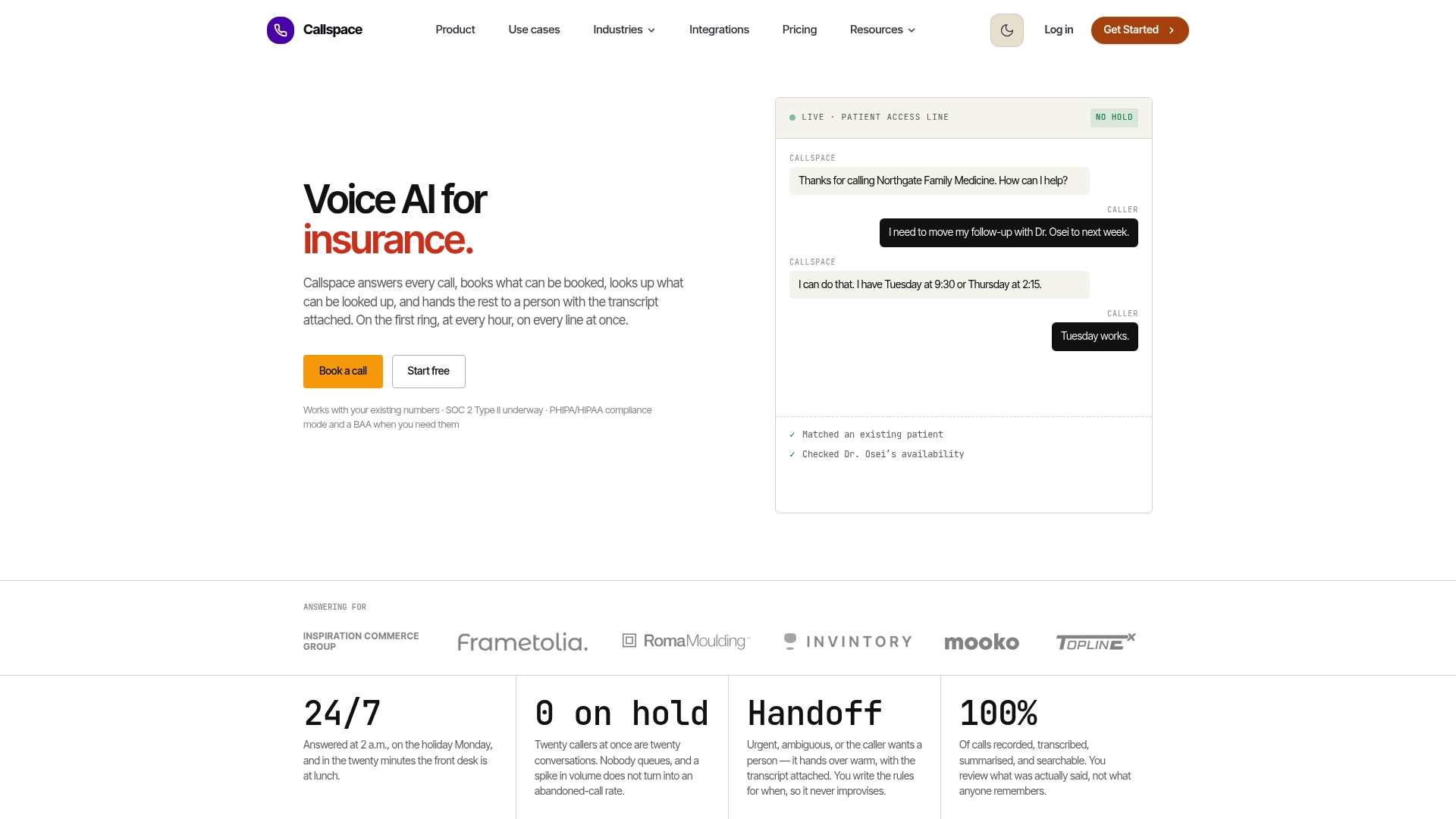
- Answers calls 24/7 with no hold times, even during peak hours
- Books and reschedules appointments through calendar and practice-management integrations
- Designed with compliance for healthcare privacy regulations in mind
- Records and transcribes calls to support quality assurance
- Transfers complex or sensitive calls to your team with relevant context attached
| Plan | Price | Best for |
|---|---|---|
| Basic | See website for current pricing | Solo or small chiropractic practices starting with automated answering |
| Team | Available on request | Multi-provider or multi-location clinics needing broader coverage |
Pro Tip: Run a free trial against your busiest hour of the week; that single hour usually reveals more than a month of average call volume.
See how this works for your specialty on the chiropractor industry page, or compare plans directly on the Callspace pricing page before you commit.
Sources
For deeper reading on privacy and virtual care obligations, consult the Competition Bureau’s digital health survey, the Office of the Privacy Commissioner’s AI guidance, and CPSO’s guidance on protecting health information. For broader clinical communication practices, the NexoLab blog covers secure messaging and consent in more depth.
- Guidance on AI and privacy — Office of the Privacy Commissioner of Canada
- Advice to the profession: Protecting personal health information — CPSO
- Privacy and the virtual care visit — Dialogue (CPSO)
FAQ
What is the average cost for an answering service?
Pricing varies by vendor and volume, but entry-level plans for small practices often start in the range of a monthly flat fee with included call minutes. Callspace’s Basic plan, for example, is $150 per month, with add-ons for higher volume or deeper integrations priced separately.
Is there a free answering service available?
Most reliable answering services charge a subscription because they involve ongoing infrastructure, call handling, and compliance work that a free tool cannot sustain. Many vendors, including Callspace, offer a free trial period so you can test the service before paying anything.
Is it safe to leave health details in a chiropractic voicemail?
Basic appointment information is generally considered reasonable to leave in a voicemail, but CPSO guidance advises against including sensitive health details and recommends confirming each patient’s preferred contact method first. When in doubt, keep the message limited to scheduling, not clinical content.
What is a red flag when evaluating a chiropractic answering service?
Vague answers about data storage, hidden per-minute fees that only surface after you ask, and no clear path for a call to reach a real person are all signs to walk away. A vendor confident in its service will answer privacy and pricing questions directly and in writing.
What is the little clicker tool chiropractors use?
That tool is an Activator, a handheld spring-loaded instrument some chiropractors use for low-force spinal adjustments instead of manual thrusts. It is a clinical device unrelated to phone systems or office administration.