Stop Sampling: AI Call Quality Monitoring Playbook for QA Managers
QA managers: how to stop manual sampling and run AI driven, near full call quality monitoring with test steps you can start this quarter.
Call quality monitoring exists to close the gap between what agents actually say on calls and what leadership assumes is happening. Its priority in 2026 is straightforward: move off manual sampling and into consistent, analytics-driven scoring that feeds coaching in near real time. Done right, it lifts first call resolution and CSAT while catching compliance risk before it becomes a churn event. The approach to call review builds on the same principle.
TL;DR:
- Automated scoring of all calls provides more consistent and comprehensive review than manual sampling, reducing missed compliance issues and improving overall quality.
- Core KPIs to track include first call resolution and CSAT for customer effort and outcomes, while metrics like AHT require careful interpretation within broader performance management.
- Transcription accuracy can drop into the high 70s in real-world conditions, so vendors should be tested with typical noisy call samples before commitment.
- Proper rollout involves phased calibration, manual validation, and gradual scaling to ensure reliable scoring and effective coaching workflows.
- Real-time transcription and context transfer enable instant flagging, targeted coaching, and reduced repeat contacts, especially for after-hours or high-volume call handling.
Table of Contents
- What Is Call Quality Monitoring, Exactly?
- Why Call Quality Monitoring Matters for the Business
- Which Metrics Actually Move the Needle?
- What Technical Capabilities Should You Actually Test?
- How Do You Roll Out a QA Program Without Breaking It?
- How Do QA Scores Actually Reach the Agent?
- Where Automated Scoring Goes Wrong
- How Real-Time Transcription Makes Full Coverage Usable
- A QA Manager’s First Week: What Actually Moves the Number
- An Alternative Worth Considering: Feeding QA From the Front Door
- Sources
- FAQ
What Is Call Quality Monitoring, Exactly?
Call quality monitoring is the practice of recording, transcribing, and scoring customer interactions against a defined rubric. It’s narrower than quality management, which also covers agent training, performance reviews, and process redesign. Monitoring feeds quality management; it doesn’t replace it.
For decades, most contact centers ran this on manual sampling, with QA analysts listening to a small percentage of calls each month. That low coverage meant most calls went unreviewed, and a single bad interaction with a VIP customer could slip through entirely undetected.
Monitoring methods generally fall into three categories:
- Silent monitoring — a supervisor listens live, without recording, often for real-time intervention.
- Recorded review — analysts score calls after the fact against a scorecard.
- Automated scoring — software transcribes and evaluates every call against defined criteria, no human listening required for the first pass.
Why Call Quality Monitoring Matters for the Business
QA isn’t a compliance chore. It’s one of the more direct levers you have on first call resolution, CSAT, and retention, because the same calls that fail your rubric tend to be the ones customers remember badly. Compliance misses, meanwhile, carry regulatory exposure that a single bad audit can turn expensive fast.
Responsiveness and accuracy are consistently the two attributes customers name as most important in a service interaction, according to Statista’s survey data on customer service priorities. Both are things a rubric can measure directly.
The 80/20 benchmark: A common service-level target across contact centers is answering 80% of calls within 20 seconds, paired with FCR goals in the 70 to 75% range depending on vertical, per industry KPI benchmarks.
A pattern QA teams see constantly: repeat contacts traced back to a knowledge gap. One agent misstates a policy, the customer calls back three days later confused, and now you’ve got two calls, two handle times, and one frustrated customer, all from a single fixable coaching moment.
Which Metrics Actually Move the Needle?
Not every number belongs on a dashboard. The metrics worth tracking split into two groups: things you react to immediately, and things you watch trend over weeks.
- First Call Resolution (FCR) — the clearest tie to customer effort and repeat-contact cost; trend metric, reviewed weekly.
- CSAT — your outcome measure; trend metric, but a sudden drop should trigger an immediate rubric review.
- Average Handle Time (AHT) — useful for capacity planning, dangerous as a standalone coaching target.
- Average Speed of Answer (ASA) and abandonment rate — real-time metrics tied directly to staffing and the 80/20 service-level goal.
- Compliance miss rate — real-time trigger; a miss on a regulated disclosure should flag for same-day review, not next week’s report.
- Coaching improvement rate — tracks whether coaching sessions actually change behavior on the next call, arguably the metric most QA programs skip.
- Churn-risk flags — sentiment or keyword triggers (cancellation language, repeated frustration) that should route to retention, not sit in a monthly report.
Salesforce’s KPI guidance frames FCR, CSAT, and AHT as the core trio worth balancing against each other, since optimizing one in isolation (chasing shorter AHT, for instance) tends to drag the others down. Build dashboards around decisions, not vanity: if a metric doesn’t trigger an action, it’s decoration.
What Technical Capabilities Should You Actually Test?
Every QA platform pitch starts with the same pipeline: audio in, transcription out, analytics layered on top. The transcription step is where most of the real risk lives, because accuracy in a vendor demo and accuracy on your actual call traffic are two different numbers.
Vendors often report transcription accuracy above 90% in controlled tests, but that figure can drop into the high 70s once you introduce background noise, regional accents, or crosstalk, according to production benchmarking data from ETSLabs. That gap is the difference between a scoring system you trust and one you have to double-check constantly.
Capabilities worth evaluating beyond raw transcription:
- Keyword and phrase detection — did the agent say the required disclosure? This remains the most reliable, immediately useful feature in production deployments, more dependable than open-ended sentiment scoring.
- Sentiment trajectory — not a single sentiment score per call, but how sentiment moves from opening to close.
- Topic classification — automatically bucketing calls by reason for contact, which feeds root-cause analysis.
- Silence and overlap metrics — dead air and talk-over rates correlate with agent confidence and customer frustration.
- Real-time coaching prompt latency — how fast a flagged issue reaches the agent’s screen, which is useless if it arrives after the call ends.
Pro Tip: Before signing any contract, send the vendor your own noisy call samples, not their demo reel. Ask for word error rate on that specific audio, test coaching-prompt latency under a simulated call volume spike, and confirm you can remap their rubric to your scorecard without an engineering ticket.
A partner tool worth understanding on its own merits is AmmarAI’s transcription technology, which illustrates how model choice and audio preprocessing affect the accuracy numbers you’ll actually see in production.
How Do You Roll Out a QA Program Without Breaking It?
Skipping straight to full automation is how QA programs lose agent trust in month one. A phased build gives you time to catch scoring errors before they touch anyone’s paycheck.
- Pilot (days 1 to 60): Pull a representative sample of real call audio, not cherry-picked “clean” calls. Draft your scorecard, weighting foundation criteria (greeting, verification, compliance disclosures) against finesse criteria (tone, active listening, resolution ownership). Run automated scoring in parallel with manual scoring on the same calls to check agreement.
- Calibrate and expand (days 60 to 90): Compare automated scores against your manual baseline and adjust thresholds where they diverge. Train supervisors on interpreting the new dashboards before you widen coverage past the pilot group. This is also when channel-specific rubrics matter, a chat-derived call and a pure voice call don’t score the same way.
- Scale and go predictive (6+ months out): Once you’re running near-full coverage consistently, start trend analysis across agent cohorts and call types. Predictive coaching, flagging an agent likely to slip before their scores actually drop, needs months of calibrated historical data before it’s trustworthy. Don’t rush this phase; a predictive model built on 45 days of data will mislead you confidently.
How Do QA Scores Actually Reach the Agent?
A score that sits in a spreadsheet changes nothing. QA only works when it routes into a coaching workflow the same day, or in some cases, the same call.
- Immediate prompts for in-progress calls (a missed disclosure, escalating frustration) should push to the agent’s screen or the supervisor’s queue instantly.
- Scheduled coaching handles pattern-level issues, like a recurring knowledge gap across five calls, best addressed in a one-on-one, not a pop-up.
- Pair QA scores with agent-side wellbeing metrics, like schedule adherence and after-call work time, so coaching reads as support rather than surveillance.
- Automate the parts that don’t need judgment: route compliance misses straight to escalation, trigger script updates when a knowledge gap repeats across agents, and queue targeted retraining modules automatically rather than waiting for a manager to notice the pattern.
Verint’s best-practices guidance is blunt about this: scoring without a coaching pipeline behind it just becomes paperwork nobody reads.
Where Automated Scoring Goes Wrong
The most common failure is trusting demo-environment accuracy numbers on your live call traffic without ever checking the gap yourself. A close second: treating aggregate sentiment as gospel when it’s actually only useful once segmented by call type and tied to outcomes like repeat-contact rate, a point research on predictive QA makes directly.
Run these checks on a schedule, not just at launch:
- Periodic manual-sample audits against automated scores, even after full rollout.
- Sentiment segmented by call type and agent group, never read as one blended number.
- Coaching improvement rate tracked over time, since a flat or falling rate means your scoring or your coaching (or both) needs a rework.
- Agent buy-in checked directly; a program agents distrust gets gamed, not improved.
Pro Tip: When scores start drifting, don’t just retrain the model quietly. Pull a fresh manual sample, compare it against the automated output, and recalibrate on a fixed cadence, quarterly at minimum, so drift never goes unnoticed for months.
How Real-Time Transcription Makes Full Coverage Usable
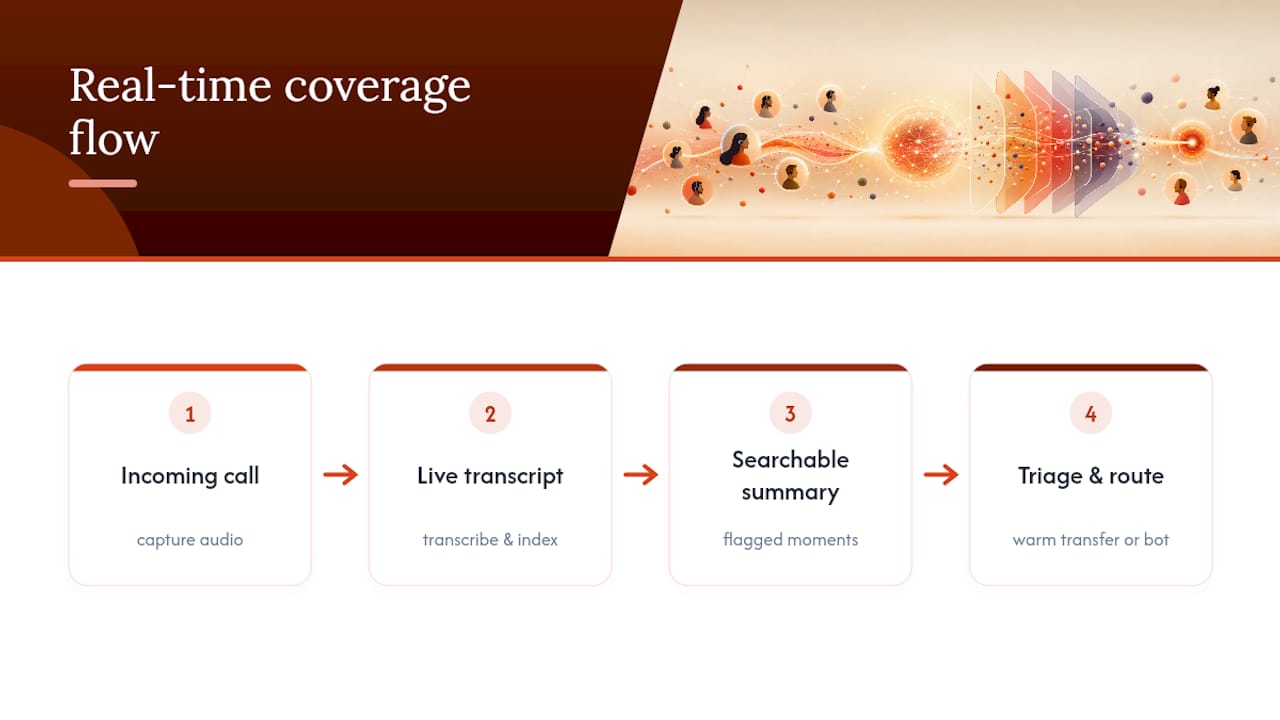
This is where real-time transcription and searchable call summaries earn their keep: instead of a supervisor listening to a 12-minute call to catch one compliance line, they scan a summary and jump straight to the flagged moment.
Context transfer, the handoff of a caller’s history and intent to a human agent mid conversation, cuts the repeat-explanation problem that quietly drags down FCR. This approach includes real-time transcription during the call itself, not a batch job hours later; context-rich warm transfers so a human agent picks up with full history, not a cold start; and 24/7 automated handling for routine inquiries and bookings, reducing the raw call volume a QA team has to triage manually.
A QA Manager’s First Week: What Actually Moves the Number
Pick one KPI, either FCR or CSAT, and baseline it before touching anything else. Run a 30-day pilot on a representative call sample, hold one calibration session comparing automated and manual scores, and change exactly one rubric criterion to test. Small, measured moves like these produce visible results faster than a full-program overhaul, because you can actually tell what caused the change.
— Sam
An Alternative Worth Considering: Feeding QA From the Front Door
Everything above assumes calls are already reaching a human, or a review queue, in the first place. Callspace works earlier in that chain: it answers inbound calls 24/7, handles bookings and routine inquiries directly, and produces a real-time transcript and summary the moment the call ends, before your QA team even opens a dashboard.
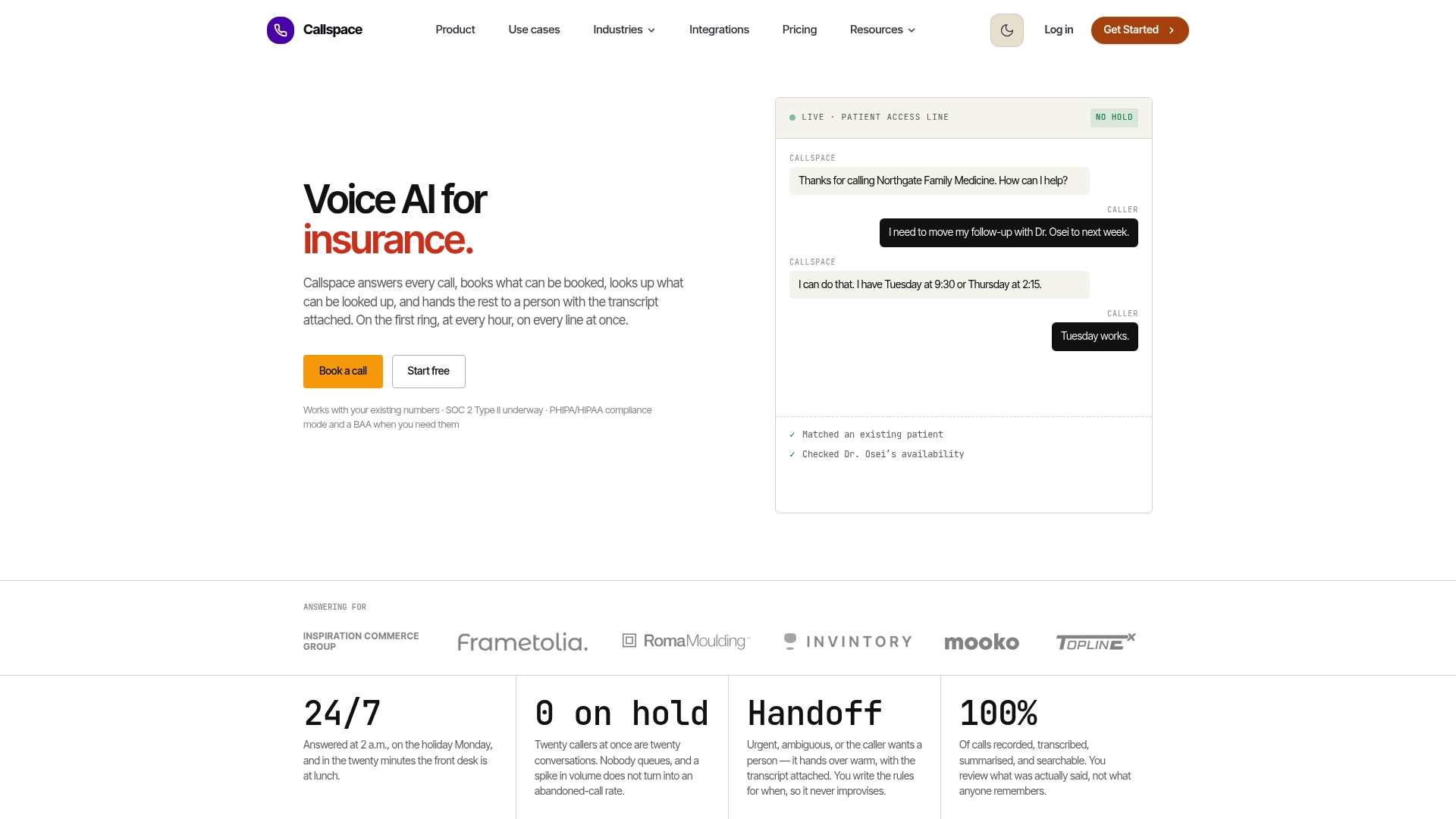
That transcript becomes your scoring input automatically, and the context transfer feature means calls that do need a human agent arrive with full history attached, cutting the repeat-contact pattern QA teams flag constantly. For call centers juggling overflow and after-hours coverage, this also means fewer abandoned calls entering your metrics as a problem to explain, since Callspace picks up what your team would otherwise miss. If you’re weighing this against building manual after-hours coverage, see how the comparison against Lippy AI breaks down. Start a trial and see what a fully transcribed call queue looks like on your own traffic.
Sources
- Call Center Quality Monitoring: Best Practices for QA
- Call center metrics and KPIs (Salesforce)
- AI Call Center Quality Monitoring: What Works in Production (ETSLabs)
- AI Call Quality Monitoring: Reactive QA to Predictive Intelligence
- Important aspects of a good customer service experience (Statista)
FAQ
What Is Call Quality Monitoring?
Call quality monitoring is the process of recording, transcribing, and scoring customer service calls against a defined rubric to track agent performance, compliance, and customer experience.
How Do You Measure Call Quality?
Track a core set of KPIs, FCR, CSAT, AHT, and compliance miss rate, then score individual calls against a weighted rubric covering both foundation criteria (greetings, disclosures) and finesse criteria (tone, resolution ownership).
How Do I Stop My Calls From Being Monitored?
If you’re a customer on a monitored line, most companies disclose recording at call start and some let you request an unmonitored transfer, but the policy varies by business and is set by whoever operates that phone line.
What Is the 80/20 Rule in Call Centers?
It’s a service-level benchmark meaning 80% of calls should be answered within 20 seconds, a target widely used across contact center operations to balance staffing costs against customer wait time.
Can AI Handle Calls Before They Reach a Human Agent?
Yes. Some AI platforms answer calls 24/7, handle bookings and routine inquiries directly, and produce transcripts for the calls that need human follow-up, reducing the volume your team has to triage manually.