Call Center Cost Reduction: AI, ROI, and Canadian Turnover in 2026
Practical 2026 playbook for cutting call center costs with measured AI containment, KPI guardrails, and workforce fixes. Includes ROI math and a Canadian...
The fastest, lowest-risk way to cut call center costs is automating repeatable tier one contacts while protecting first call resolution, not slashing headcount. Combine measured AI containment, skills-based routing, and workforce management fixes, since cutting one lever without the others usually just moves cost around. Callspace clients see this play out in practice: contain the easy calls, and the industry median cost per contact near $6 starts trending down for real.
TL;DR:
- Automating simple tier one contacts using AI can contain up to 30-60 percent of eligible calls, significantly reducing the fully loaded cost per contact.
- Monitoring key KPIs such as cost per contact, first call resolution, handle time, and abandonment rate is essential before making staffing or vendor contract cuts.
- Skills-based routing improves first call resolution and reduces transfers, which directly lowers overall call handling costs.
- Optimizing workforce management by accurately forecasting, flexible scheduling, and controlling shrinkage can cut labor costs without sacrificing service levels.
- Reducing turnover through competitive pay, development, and improved onboarding can lower costs more effectively than one-time cuts or automation alone.
Table of Contents
- What Metrics Should You Track Before Cutting Call Center Costs?
- Automate and Contain Repeatable Contacts With AI and Self-Service
- How Does Skills-Based Routing Cut Call Center Costs?
- Optimize Workforce Management to Cut Labor Costs Per Contact
- Why Reducing Turnover Lowers Your Total Call Center Cost
- Better Knowledge Bases and QA Reduce Repeat Contacts
- Should You Shift Calls to Chat, Email, or Nearshore Teams?
- Cut Infrastructure Costs Without Breaking Your Integrations
- What Is the ROI of Call Center Automation?
- How Lean and Six Sigma Cut Waste in Call Centers
- How Workspace Layout Affects Call Center Costs
- What Regulatory Compliance Actually Costs Your Call Center
- Why Cost Reduction Needs to Be an Ongoing Discipline, Not a One-Time Cut
- Where Callspace Fits Into Your Cost Reduction Plan
- Sources
- FAQ
What Metrics Should You Track Before Cutting Call Center Costs?
Before you touch staffing or vendor contracts, get honest about your fully loaded cost per contact. That figure includes wages, shrinkage, tooling licenses, management overhead, and training amortization, not just the hourly rate on an agent’s paycheck. Most operations underestimate this number by 20 to 30 percent because they forget shrinkage and management layers.
Six KPIs deserve a monthly look, read together rather than in isolation:
- Cost per contact: cross-industry median sits near $6, though healthcare runs closer to $6.90 and insurance to $11.00 because of complexity and compliance overhead.
- First call resolution (FCR): the single best predictor of repeat contact volume.
- Average handle time (AHT): useful only when paired with FCR, since a shorter call that requires a callback costs more overall.
- CSAT: your early warning system for cuts that are quietly damaging experience.
- Occupancy and shrinkage: the hidden multipliers behind your real staffing math.
- Call abandonment rate: a leading signal of understaffing or broken routing.
The most common failure mode is celebrating deflection numbers that hide unresolved issues, or accepting per-interaction billing from a vendor that charges the same whether the contact resolves or not.
Automate and Contain Repeatable Contacts With AI and Self-Service
Start by identifying your tier one contact types: appointment changes, order status, hours and location questions, basic eligibility checks. Run a simulation against six months of historical transcripts to see what percentage a voice AI system could plausibly resolve without a transfer. This step matters more than any vendor’s marketing claim, because your actual call mix determines your real savings.
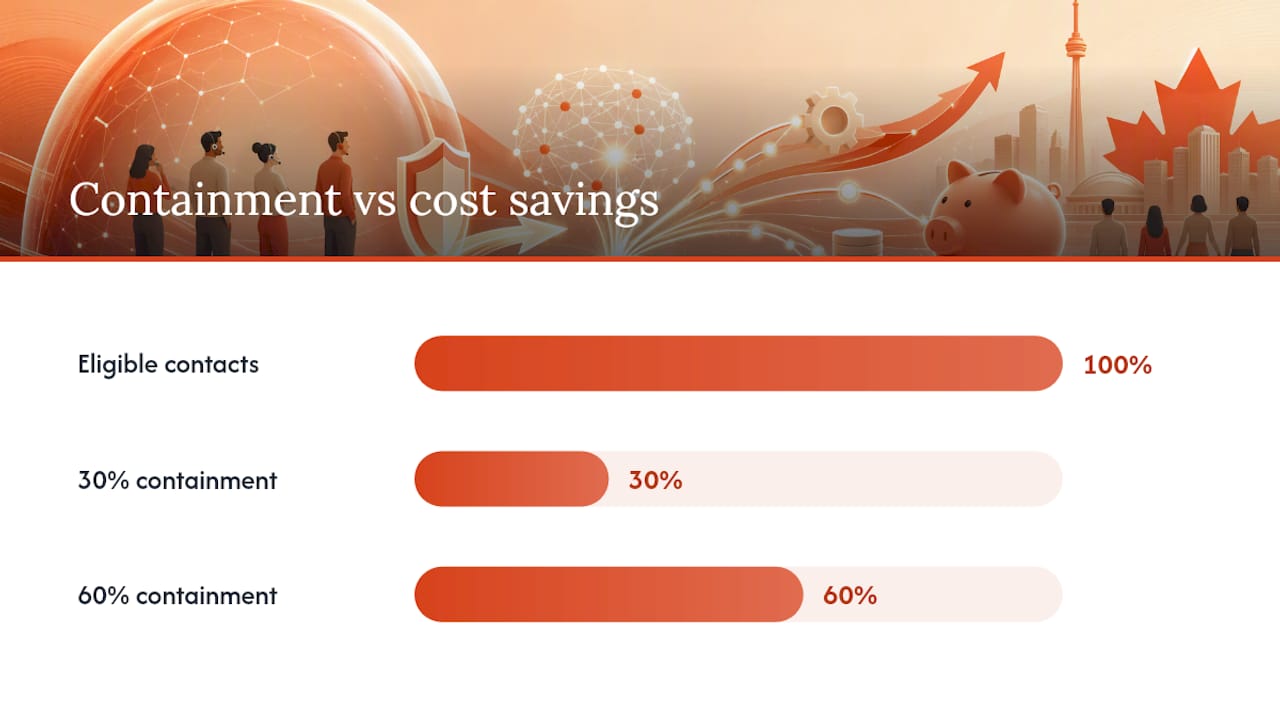
The math is straightforward once you have a resolution rate. If automation contains 30 percent of eligible contacts, you save roughly 30 percent of the fully loaded cost on those calls. Push resolution to 60 percent through better prompts and integration, and savings roughly double, since the relationship is close to linear until you hit the harder, more complex calls that genuinely need a human.
Pro Tip: Avoid vendors that charge per interaction regardless of outcome. Push for pricing tied to resolutions or a predictable monthly volume during your pilot, so a slow month doesn’t inflate your cost per contact.
Gartner’s research backs a measured approach here: a 2025 survey found only 20 percent of customer service leaders reported AI-driven headcount reduction, which tells you AI is delivering FCR and productivity gains first, staffing cuts second, if at all.
How Does Skills-Based Routing Cut Call Center Costs?
Routing gets less attention than automation, but it often produces faster wins. When calls land with an agent who lacks the right skill set, you get transfers, repeat contacts, and inflated handle time, all of which drive up your true cost per contact even when AHT on any single call looks fine.
Skills-based routing solves this by matching caller intent, gathered from IVR selections or a brief pre-screen, to the agent best equipped to resolve it on the first attempt. Done well, it lifts FCR and shrinks transfer and reopen rates simultaneously, which is the combination that actually moves your cost curve.
Before rolling out new routing rules everywhere, pilot on a narrow slice:
- Pick two or three high-volume, high-transfer contact types.
- Map the skill or agent group that resolves each fastest today.
- Route only those types through the new logic for two weeks.
- Track transfer rate, FCR, and AHT against your baseline before expanding.
Optimize Workforce Management to Cut Labor Costs Per Contact
Shrinkage and occupancy are the two numbers that quietly wreck staffing budgets when ignored. Shrinkage measures the gap between paid hours and hours actually available to take calls, covering breaks, training, meetings, and absenteeism. Occupancy measures how much of an agent’s available time is spent actually handling contacts versus waiting. Skip either one in your staffing model, and you’ll either overstaff out of caution or understaff and blow your service levels.
Three moves tend to produce the fastest labor savings:
- Forecast at the interval level, not just daily or weekly averages, since call volume swings by hour can be dramatic even when daily totals look stable.
- Build a flexible staffing layer using part-time shifts, voluntary shift swapping, and a vetted temp pool for predictable seasonal spikes.
- Track overtime and idle time separately each week, since both represent wasted labor dollars that a tighter forecast usually eliminates within one or two scheduling cycles.
Centers that tighten interval forecasting typically see overtime drop first, often within the first full scheduling cycle, because managers stop overcorrecting for yesterday’s staffing miss.
Why Reducing Turnover Lowers Your Total Call Center Cost
Turnover is one of the most underpriced line items in a call center budget. The average cost of turnover in Canada reached $30,680 per employee in 2026, covering recruiting, lost productivity during ramp, and the training investment that walks out the door with every departing agent.
One avoided exit can fund a meaningful chunk of a scheduling software upgrade or a full onboarding overhaul, which is why retention deserves budget priority alongside automation.
A handful of levers move retention more than generic engagement surveys ever will:
- Competitive pay bands reviewed at least annually against your local labor market.
- Real development paths, not just tenure-based raises, so agents see a future beyond the phone.
- Manager quality, since most agents quit a supervisor, not the job itself.
- Recognition tied to specific outcomes like FCR improvement, not just attendance.
- Flexible scheduling options, including hybrid or remote shifts where the role allows it.
Onboarding speed matters just as much. Structured shadowing, AI-assisted call guidance during the first weeks, and short microlearning modules instead of week-long classroom training all shrink time-to-competence, which shrinks the window where a new agent is costing more than they’re saving.
Better Knowledge Bases and QA Reduce Repeat Contacts
A searchable, well-tagged knowledge base is worth more to your cost structure than most managers realize, because every repeat contact caused by an agent giving the wrong answer costs you twice. Agents need retrieval tools that surface the right policy or procedure in seconds, not a wiki that requires ten minutes of scrolling mid-call.
Quality assurance should score against FCR outcomes and coaching impact, not just compliance checklists. A QA program that only checks whether an agent said the required disclosure misses the real driver of repeat contacts: whether the issue actually got solved.
- Tag your knowledge base by contact reason, not by department structure.
- Score QA against resolution accuracy, then coach specifically to the gap you find.
- Give agents inline assist tools that suggest next steps during the call itself.
- Review QA and FCR data together monthly to catch drift before it becomes a trend.
Pro Tip: If average handle time creeps up slightly after you add agent-assist tools, don’t panic. A small AHT increase paired with a meaningful FCR gain almost always nets a lower total cost, since you’re trading a few extra seconds for one less repeat call.
Should You Shift Calls to Chat, Email, or Nearshore Teams?
Not every contact needs a live voice conversation. Chat and email support concurrency, meaning one agent can often handle several conversations at once, and industry benchmarks show AI-contained voice interactions can cost as little as $0.08 to $0.35 per contact for the simplest cases, while async channels typically run cheaper than live voice for anything that doesn’t need real-time back and forth.
Nearshore and remote delivery models can lower labor cost per hour, but they carry real governance requirements. Time zone alignment, language nuance, and quality consistency all need active monitoring, or you’ll trade a labor savings for a CSAT problem that costs more to fix later.
- Pilot channel shifts on low-complexity contact types first, like order status or appointment confirmations.
- Set a CSAT floor for any pilot; if it drops below that line, pause and diagnose before scaling.
- For nearshore or remote pilots, run parallel QA scoring against your onshore baseline for at least one full quarter.
- Track rework and reopen rates separately, since a channel shift that looks cheap on paper can hide costly follow-up contacts.
Cut Infrastructure Costs Without Breaking Your Integrations
Cloud contact center platforms typically lower total cost of ownership by eliminating on-premise hardware refresh cycles and letting you pay for capacity you actually use. The common migration pitfall is underestimating integration work, since your CRM, workforce management tool, and telephony provider all need to talk to each other cleanly after the switch.
License audits are usually the quickest win available. Most centers carry seats for tools nobody logs into monthly, and billing units that don’t match actual usage.
- Run a license audit every six months and reclaim unused seats immediately.
- Align billing units, per-seat, per-minute, per-interaction, to how your team actually consumes the tool.
- Negotiate telephony and per-interaction charges annually, using your actual volume data as leverage.
- Consolidate point solutions where one platform can reasonably replace two or three narrow tools.
What Is the ROI of Call Center Automation?
The standard formula for measuring this is simple: ROI equals annual savings minus annual investment, divided by annual investment. Three sources feed the savings side: contacts fully handled without an agent, faster handle time on contacts agents still take, and agent hours freed up for higher-value work.
Here’s a conservative worked example for a center handling 10,000 monthly contacts, where a voice AI platform contains 25 percent of eligible tier one calls at a fully loaded cost of $6 per contact:
| Line Item | Monthly Value |
|---|---|
| Contacts contained by automation | 2,500 |
| Cost saved per contained contact | $6 |
| Gross monthly savings | $15,000 |
| Estimated platform investment | $4,000 |
| Net monthly savings | $11,000 |
| Approximate payback period | Under 1 month |
Even at a more cautious 15 percent containment rate, the same center would save $9,000 gross monthly, still clearing a healthy net return after platform cost. Gartner’s own projection suggests generative AI’s cost-per-resolution advantage may exceed offshore human-agent savings by 2030, a useful data point when you’re weighing a nearshore expansion against an automation investment over a multi-year horizon.
To track ROI accurately, measure integration touchpoints directly: calendar booking completions, practice management or EMR lookups, Shopify order status pulls, and warm transfer volume with context intact. Callspace’s call center product page outlines the integration points most operations teams use to build this kind of tracking from day one.
How Lean and Six Sigma Cut Waste in Call Centers
Lean and Six Sigma both treat cost reduction as a byproduct of removing waste, not a target you chase directly by cutting people. Lean focuses on eliminating non-value-adding steps: unnecessary hold time, redundant verification questions, screens agents have to click through for no customer benefit. Six Sigma focuses on reducing variation, the reason two agents handle the identical call type in wildly different amounts of time.
A basic Lean pass through your call flow usually finds two or three scripted steps that add call duration without adding customer value, things like redundant identity verification already confirmed by the IVR, or a mandatory upsell mention that most agents skip anyway because it derails the call.
Six Sigma’s DMAIC cycle, define, measure, analyze, improve, control, works well for chronic AHT variation between agents or shifts. Define the specific contact type causing the spread, measure actual handle times across your team, analyze what the fastest resolvers do differently, then build that behavior into training and QA scoring so it sticks.
Neither methodology requires a certification program to start. A quarterly review where you pick one contact type, map every step, and cut what doesn’t serve the customer will produce measurable AHT and cost per contact improvement within one or two cycles, especially when you close the loop by updating your knowledge base and QA rubric to match.
How Workspace Layout Affects Call Center Costs
Physical and virtual workspace design shapes productivity more than most cost-cutting plans account for. Open floor plans built for headcount density often increase background noise on calls, which lengthens handle time as agents ask customers to repeat themselves and raises the error rate on information capture.
Acoustic separation, whether through physical partitions or noise-canceling headsets, tends to produce a measurable drop in average handle time for voice-heavy teams, since agents spend less time re-confirming what they heard. Lighting and desk ergonomics matter for a less obvious reason: fatigue late in a shift correlates with slower resolution and higher error rates that generate callbacks.

For remote and hybrid teams, workspace cost shifts from real estate to technology reliability. A distributed team saves on office lease costs but needs consistent internet connectivity standards and a monitoring system for call quality issues tied to home network problems, or you’ll trade a real estate saving for a CSAT problem nobody catches until it shows up in survey scores.
The practical move for most centers is auditing your current layout or remote setup against one metric: how much unplanned noise or connectivity friction shows up in your QA call recordings each month. If it’s a recurring theme in call reviews, the fix, whether it’s better headsets, a quieter room assignment, or a minimum bandwidth requirement for remote agents, usually pays for itself through lower AHT and fewer repeat contacts within a quarter.
What Regulatory Compliance Actually Costs Your Call Center
Compliance is a budget line that grows quietly and rarely gets its own review cycle, which is exactly why it deserves one. Healthcare centers carry HIPAA-related recording, storage, and access control requirements. Insurance and financial services centers carry call recording retention rules and disclosure scripting mandates that add scripted seconds to every call. Each requirement adds real cost: specialized storage, access logging, and staff training that general customer service centers don’t carry.
The budgeting mistake most operations make is treating compliance cost as fixed overhead instead of something that scales with contact volume and channel mix. Every new contact channel you add, chat, a new IVR tree, an AI-driven answering layer, needs its own compliance review before launch, not after a complaint surfaces the gap.
Build compliance cost into your automation and channel decisions from the start rather than retrofitting it. A voice AI platform serving healthcare or insurance clients needs to handle recording, transcription, and access controls to the same standard your human agents follow, which is why compliance capability belongs on your vendor evaluation checklist alongside price and integration depth, not as an afterthought once a contract’s already signed.
Why Cost Reduction Needs to Be an Ongoing Discipline, Not a One-Time Cut
The centers that get cost reduction wrong treat it as an event: a headcount cut, a vendor switch, a single automation rollout, then back to business as usual. That approach almost always reverses within a year, because the underlying drivers of cost, poor routing, weak knowledge tools, unmanaged shrinkage, never actually got fixed.
Run cost reduction the way you’d run any other operating discipline, with a real cadence. Review your six core KPIs monthly. Test one new pilot, whether it’s a routing change, an automation expansion, or a staffing model tweak, every quarter. Revisit your full technology and vendor roadmap annually against updated volume and cost data.
This only works with cross-functional ownership. Finance needs to see the KPI dashboard alongside operations, and every savings claim needs a specific, measurable target attached to it before you greenlight the initiative, not after. A cut that can’t be traced to a KPI outcome usually isn’t a real cut. It’s a number that looks good in a slide deck until the next quarter’s report shows costs creeping back.
— Sam
Where Callspace Fits Into Your Cost Reduction Plan
If tier one automation is the lever you’re ready to pull, an AI-powered voice assistant handles the job directly: instant call answering, appointment booking, order lookup through Shopify, routine inquiry resolution, and after-hours overflow coverage, with warm transfers that hand human agents full context instead of a cold callback.
Most operations teams measure ROI on this kind of deployment through a handful of integration touchpoints: calendar systems for booking completions, practice management or EMR platforms for healthcare workflows, Shopify for order status, and CRM systems for warm transfer logging. Such a platform connects to these systems, and real-time transcription means every call gets recorded and summarized automatically for QA review, which feeds directly into the KPI cadence described above.
A typical pilot runs on a narrow contact type first, appointment scheduling or order status is a common starting point. You can measure containment rate and CSAT before expanding scope. Explore how it fits your industry’s specific call patterns and start a trial to see your actual containment rate against your own call volume.
Sources
- Call center KPI benchmarks by industry
- Gartner survey finds only 20 percent of customer service leaders report AI-driven headcount reduction
- Average cost of turnover in Canada rises to more than $30,000
FAQ
What is the 80/20 rule in a call center?
The Pareto principle typically means most of your call volume comes from a small percentage of contact reasons, which is why prioritizing automation and process fixes on your top few contact types delivers most of your available savings.
What is the average cost per call at a call center?
Cross-industry median cost per contact sits around $6, though it varies by sector: healthcare runs closer to $6.90 and insurance closer to $11.00 due to added complexity and compliance requirements.
What is a typical shrinkage rate for call centers?
Shrinkage rates vary widely by operation, but most centers need to account for both direct shrinkage, like breaks and training, and indirect shrinkage, like meetings and system downtime, when building realistic staffing models.
How can I reduce costs without cutting staff?
Automate repeatable tier one contacts with an AI-powered voice assistant platform, tighten routing to cut transfers and repeat calls, and fix shrinkage and forecasting gaps in your workforce management, all of which lower cost per contact without a single layoff.
Does AI automation actually reduce call center headcount?
Not immediately for most operations. A 2025 Gartner survey found only 20 percent of customer service leaders reported AI-driven headcount reduction, with most gains showing up first as improved FCR and agent productivity rather than staff cuts.