AI Phone Agents: 6 Trial Checks to Run Before You Choose
Compare AI phone agents using six feature checks, a repeatable demo test, and a recommended platform for booking, call coverage, and staff handoffs.

For most businesses comparing AI voice platforms, Callspace stands out as the recommended pick because it answers every call instantly, books appointments without a human on the line, and hands off complex issues to staff with a full transcript in hand. It pairs that with compliance-ready consent handling for regulated industries. The sections below walk through how we tested that claim and how you can run the same evaluation on any vendor you are considering.
TL;DR:
- Test support, booking, order lookup, outbound qualification, escalation, and consent workflows at least ten times per vendor, recording completion, latency, and transcript accuracy.
- Aim for about 85% completion on simple booking flows and latency below 400 milliseconds; weaker results signal a need for configuration before launch.
- For Canadian callers, document consent through multiple methods; collecting voiceprints can require express, informed consent under 2026 guidance.
- Pilot one workflow, such as a single service line, for two to four weeks before expanding across locations.
- Compare total costs by checking per minute or per seat billing, transcription retention, voice model fees, and integration charges rather than relying on headline rates.
Table of Contents
- Article Takeaways: Who Benefits and the Quick Wins to Expect
- What an AI Phone Agent Actually Does: A Practical Feature Checklist
- How to Evaluate AI Phone Agents: A Reproducible Testing Protocol
- Why Callspace Is Our Recommended Pick: Feature Mapping and Fit Cases
- Implementation Timeline, Pricing Shape, and ROI Illustration
- How We Tested This and What to Insist on in Demos
- What the Industry Gets Wrong About AI Phone Agents
- Getting Started With Callspace: Trial, Pricing, and Next Steps
- FAQ
- Sources
Article Takeaways: Who Benefits and the Quick Wins to Expect
If your front desk or call center loses leads to voicemail, hold music, or after-hours gaps, an AI phone agent is worth a serious look this quarter. The technology fits four recurring jobs particularly well, and the wins show up fast once a deployment is live.
- Inbound coverage: every call gets answered on the first ring, including nights, weekends, and lunch breaks when staff can’t pick up.
- Appointment booking: the agent checks your calendar and confirms a slot without a staff member touching the phone.
- Lead qualification: routine screening questions get asked consistently, so sales or intake staff only see calls worth their time.
- Overflow handling: when every line is busy, the agent absorbs the spike instead of sending callers to voicemail.
Operationally, practices and call centers that adopt this well tend to see fewer missed calls, cleaner transcripts and summaries for every interaction, and faster warm transfers because the human who picks up already has context instead of starting cold.
There are cases where it makes sense to hold off. Workflows that involve sensitive legal advice, crisis intervention, or highly judgment-dependent counseling still call for a human on the line from the first word, and no amount of workflow tuning changes that. For nearly everything else, the technology has matured enough to deserve a real trial rather than a dismissal.
What an AI Phone Agent Actually Does: A Practical Feature Checklist
Marketing pages tend to blur together, so it helps to know exactly what capabilities separate a genuinely useful platform from a glorified voicemail tree. Here is the checklist we use when evaluating a vendor’s live demo rather than its sales deck.
- Live answering with multi-turn understanding: the agent should follow a conversation across several exchanges, not just match keywords to a script.
- Booking actions: it should read your calendar, offer real openings, and confirm the appointment back to the caller in the same call.
- CRM and system writes: completed calls should create or update a record automatically, not just leave a voicemail-style note.
- Warm transfers with context: when a call escalates, the receiving staff member should get a summary and the live caller, not a cold handoff.
- Transcription and summaries: every call should produce a written record for quality review and dispute resolution.
- Channel coverage: the strongest platforms extend the same logic to SMS and web chat, and connect to calendars, Shopify, or practice management software rather than operating as an island.
Pro Tip: Ask any vendor to run a live, unscripted call during the demo instead of a pre-recorded walkthrough, since scripted demos hide exactly the failure modes you need to see.
When you sit through a demo, resist the urge to just listen for a pleasant voice. Test four operational behaviors directly: how accurately the agent identifies what the caller actually wants, whether a transfer preserves context or drops it, how much silence passes before the agent responds, and whether it can complete a multi-step task like rescheduling an existing appointment rather than just booking a fresh one. Voice quality has become table stakes across the category; the real gaps show up in whether the agent finishes the job.
How to Evaluate AI Phone Agents: A Reproducible Testing Protocol
Most buyers judge AI phone platforms on voice quality alone, which is the wrong filter. Once a platform’s voice is natural enough that callers don’t hang up in confusion, the decision should shift to five harder dimensions: voice quality and latency, workflow execution, integration depth, reporting and governance, and pricing predictability. A platform that sounds great but fails to write a booking into your calendar correctly is not a time saver, it’s a new source of errors.
The cleanest way to compare vendors is to run the same set of calls against each one and record what happens. We recommend six scenarios that mirror the calls a real front desk handles in a typical week:
- A support question the agent should answer directly from information you provide (hours, pricing, policies).
- An appointment booking that requires checking real calendar availability and confirming back to the caller.
- An order lookup that pulls a live record, such as a Shopify order status.
- An outbound qualification call where the agent asks a short set of screening questions and logs the answers.
- An escalation scenario where the caller gets angry or asks for something outside the agent’s scope, testing the handoff to a human.
- A consent capture scenario where the agent must clearly state that the call is recorded and obtain agreement before continuing.
Run each scenario at least ten times per vendor, ideally as part of a randomized 50-call pilot, and log four numbers for every run: whether the task completed end to end, where it failed when it didn’t, how long the agent took to respond after the caller finished speaking, and how accurate the transcript was against what was actually said.
One benchmark worth anchoring to: background research on production voice deployments suggests aiming for roughly 85% successful end-to-end completion on simple booking flows across a randomized pilot, with response latency under 400 milliseconds for the interaction to feel natural rather than stilted. Treat anything well below that completion rate as a signal the platform needs more configuration before go-live, not as a reason to abandon the category.
Compliance deserves its own line item in the protocol, separate from functional testing. The Office of the Privacy Commissioner of Canada clarified in 2026 that voiceprints count as sensitive biometric information, which means collecting them can require express, informed consent rather than the implied consent that covers basic call recording. Separately, PIPEDA guidance on recording customer calls recommends documenting consent in more than one way, such as a recorded verbal opt-in combined with a written confirmation sent after the call, to meet a meaningful-consent standard. When you test a vendor, ask specifically how voice data is retained, who can access it, and how a caller’s request for deletion gets fulfilled. If outbound calling is part of your use case, the CRTC’s Unsolicited Telecommunication Rules make clear that your business, not just the vendor, can be held responsible for violations, so your contract should include audit rights and compliance reporting, not just a service-level agreement on uptime.
Why Callspace Is Our Recommended Pick: Feature Mapping and Fit Cases
Mapped against that checklist, we built our platform specifically to close the gaps that show up in a rigorous trial rather than to win a quick demo. Every call gets answered without a queue, including during peak periods when call volume would otherwise push people to voicemail or an abandoned call.
- 24/7 answering: calls get picked up at any hour, so after-hours inquiries don’t wait until the next business day.
- Appointment booking: the agent checks calendar or practice management availability and confirms a real slot during the call itself.
- Shopify order lookups: e-commerce callers get a live order status instead of being asked to check their e-mail.
- Real-time transcripts and summaries: every call is transcribed and summarized for quality review, so nothing depends on a staff member’s memory of what was said.
- Warm transfers: when a call needs a human, the receiving staff member gets the live caller plus a summary of what already happened, not a cold pickup.
- Calendar and practice management integrations: booking actions write directly into the systems your staff already use.
For insurance agents, that typically plays out as a caller asking about a claim status getting a direct answer or a warm transfer with full context to the right adjuster, instead of leaving a message that sits in a queue. For healthcare clinics, it looks like a patient booking a follow-up visit outside office hours, with the appointment landing in the practice’s existing scheduling system by the time staff arrive the next morning. For e-commerce merchants, it means a customer asking “where’s my order” gets a live Shopify lookup instead of a generic “we’ll get back to you” message.
PIPEDA guidance on consent capture recommends logging consent in more than one place, and our transcription and summary records give practices an auditable trail alongside the recorded opt-in itself. For a closer look at how consent language should be structured for Canadian callers, our guide to call recording consent walks through practical scripts.
Pro Tip: Scope a proof-of-concept around one real workflow, such as appointment booking for a single service line, and measure completion rate and transfer quality for two weeks before expanding to the rest of your call volume.
Success in that proof-of-concept looks concrete: a measurable drop in missed calls, bookings landing correctly in your calendar without manual correction, and front-line staff reporting that warm transfers actually save them time instead of adding a layer of verification.
Implementation Timeline, Pricing Shape, and ROI Illustration
Rolling out an AI phone agent is not an overnight switch, but it moves faster than most legacy software deployments. Discovery, where you map call types, integrations, and escalation rules, typically runs one to two weeks. A pilot on a single phone line or service follows for two to four weeks, long enough to run the testing protocol above on real calls. Full scale-up across every line generally takes another four to twelve weeks, with the range driven mostly by how many systems need to be connected, such as a practice management platform plus a calendar plus Shopify, rather than by the AI itself.
- Discovery (1 to 2 weeks): define call types, required integrations, and when a call should escalate to a person.
- Pilot (2 to 4 weeks): run the agent on one line or one workflow, using the six-scenario protocol to catch failure modes early.
- Scale (4 to 12 weeks): extend to additional lines or locations once the pilot’s completion rates and transfer quality hold steady.
Pricing in this category is generally shaped by a few recurring drivers: whether billing is per minute or per seat, how long transcription records are retained, whether a premium voice model is used, and whether integration setup carries its own fee. Those drivers are worth asking about explicitly in a vendor’s proposal, since they affect total cost more than the headline rate does.
To illustrate the math, not as a market figure but as a worked example: say a clinic currently misses 40 calls a month after hours, and historically about a quarter of callers who reach voicemail never call back or book elsewhere. If an AI phone agent recovers 30 of those 40 calls into booked appointments, and each booked appointment is worth $150 in billed services, that’s $4,500 in recovered monthly revenue, or $27,000 over six months, before accounting for the platform’s own subscription cost. Run the same arithmetic against your own missed-call volume and average ticket size before committing to a plan size.

How We Tested This and What to Insist on in Demos
This evaluation was built around the six-scenario protocol described above: a support question, a booking flow, an order lookup, an outbound qualification call, an escalation to a human, and a consent capture scenario, run repeatedly and logged for completion, latency, and transcript accuracy. We chose those six because they cover the actual range of calls a front desk or contact center handles in a given week, not just the easy cases a sales demo tends to showcase.
Industry analysis of conversational AI deployments points in the same direction: Gartner’s research on contact center automation recommends weighing governance and integration readiness alongside raw performance, which is exactly where many vendor comparisons fall short. When you sit through your own demos, insist on an unscripted call, a real integration write-back you can verify, and a compliance walk-through of consent and retention, not just a polished voice sample.
What the Industry Gets Wrong About AI Phone Agents
Most vendor comparisons treat voice naturalness as the deciding factor, and that’s a mistake. Once a platform clears a basic threshold for sounding human, the differences that actually affect your business live in workflow completion, integration reliability, and how cleanly a call hands off to a person when it should. A beautiful voice attached to a system that mangles a booking or drops context on transfer costs you more than a slightly robotic voice attached to a system that gets the job done.
The second place conventional advice falls short is compliance. Buyers often treat consent language as a legal afterthought to bolt on after launch, when it should be part of the first test call you run. Voice data is sensitive, retention policies matter, and the vendor’s default settings are rarely tuned to your specific regulatory obligations.
If you take one thing from this evaluation, prioritize running real calls through the six-scenario protocol before you sign anything. A demo tells you what a vendor wants you to see; a pilot tells you what actually happens on your phone line.
— Sam
Getting Started With Callspace: Trial, Pricing, and Next Steps
If the evaluation above convinced you it’s time to stop losing calls to voicemail, we offer two plans built for different stages of growth: Basic, priced at $150 per month, fits a single location or service line running its first pilot, while Team scales to multiple lines and locations with pricing available on request.
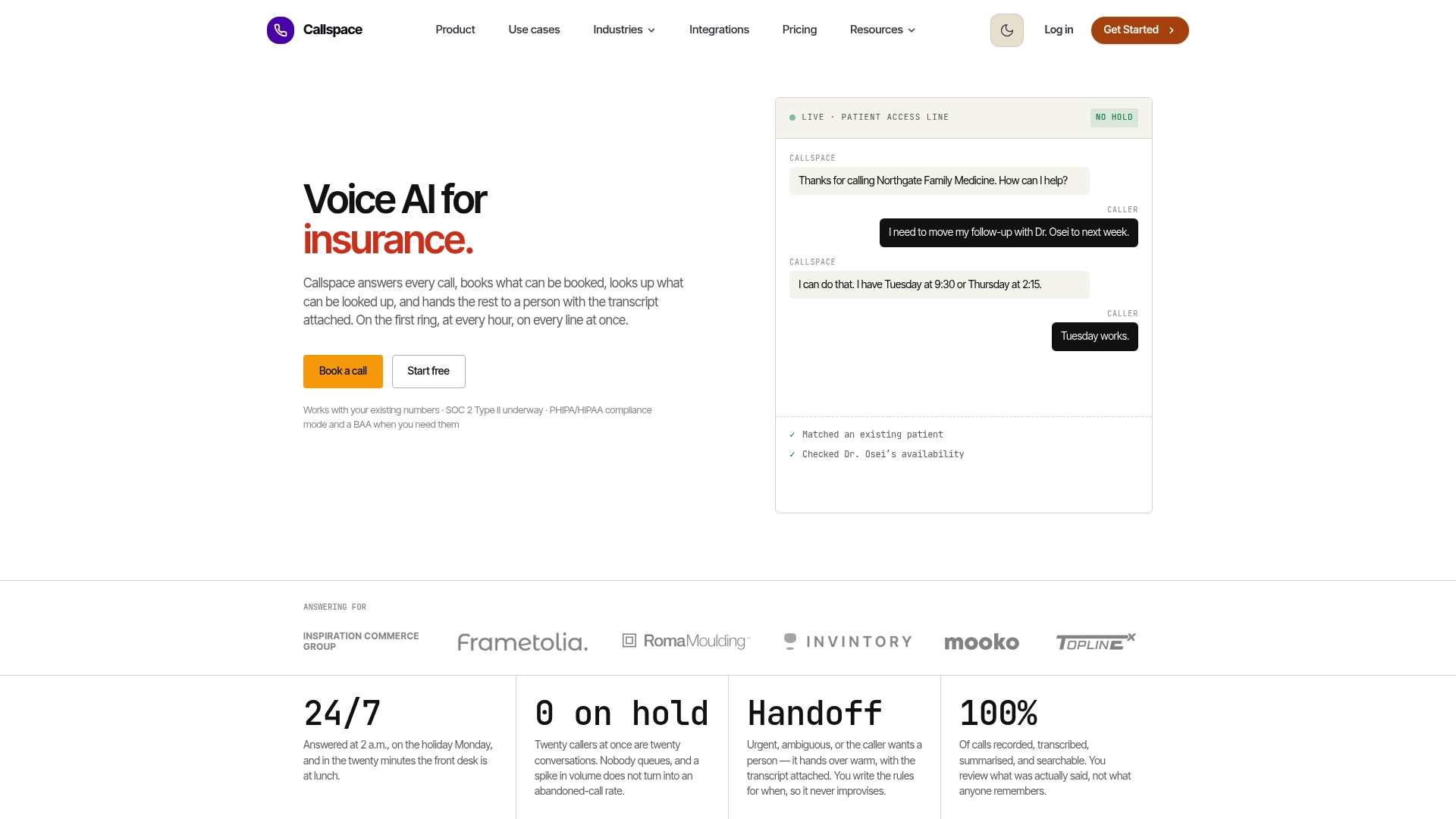
Before you commit, request a trial that mirrors the testing protocol in this article rather than a canned walkthrough.
- Ask us to run an end-to-end booking flow against a real calendar, not a mock one.
- Ask for a live demonstration of a CRM or practice management write-back so you can confirm the data lands correctly.
- Ask to see the consent capture flow in action, including how a caller is informed the call is recorded.
Industry-specific pages for insurance agents, real estate teams, and financial advisors show how the same core platform adapts to different call patterns. Visit our pricing page to compare Basic and Team, or book a live demo to see your own call scenarios handled in real time.
FAQ
What Are the Best AI Phone Agents for Businesses to Use?
The strongest platforms combine live multi-turn conversation, real appointment booking, system integrations, and clean call transcripts rather than just a natural-sounding voice. Our own platform, Callspace, is built around that combination, with plans listed on our pricing page.
What Is the Best AI Answering Service for Small Businesses?
The best fit for a small business is a platform that answers every call instantly, books appointments directly into an existing calendar, and hands off complex calls to staff with context intact. Our Basic plan is priced at $150 per month and is designed for a single location running its first deployment.
Which AI Voice Mode or Style Works Best for Phone Calls?
There is no single best voice style across every business; what matters more is whether the voice responds quickly, with latency under roughly 400 milliseconds, and handles natural back-and-forth conversation without breaking down. Test any vendor’s voice on an unscripted call rather than a pre-recorded sample before judging it.
How Do I Verify an AI Phone Agent Is Compliant With Call Recording Rules?
Confirm the platform clearly informs callers that the call is recorded and captures consent in more than one way, since PIPEDA guidance recommends documenting consent through methods like a recorded opt-in plus a written confirmation. If the platform collects voiceprints, check that it follows the updated 2026 guidance on biometric voice data, which treats voiceprints as sensitive information requiring express consent.
What Should I Test Before Choosing an AI Phone Agent Platform?
Run the same set of calls, a support question, a booking, an order lookup, an outbound call, an escalation, and a consent scenario, against any platform you’re considering before signing a contract. Record completion rates, response latency, and transcript accuracy so you’re comparing vendors on real performance instead of a sales demo.
Sources
- News release: OPC updates guidance on safe handling of voice data when recording customer calls
- Unsolicited Telecommunication Rules: Know Your Obligations | CRTC