Your AI agent
Teaching your agent about your business
Keep your business profile current, teach your agent rules in plain English, and upload the documents and web pages it should quote from.
Updated
Your agent learns about your business from three places: the business profile you fill in once, the rules you teach it in plain English, and the knowledge sources you add as you go. All three are worth a pass in your first week.
Your business profile
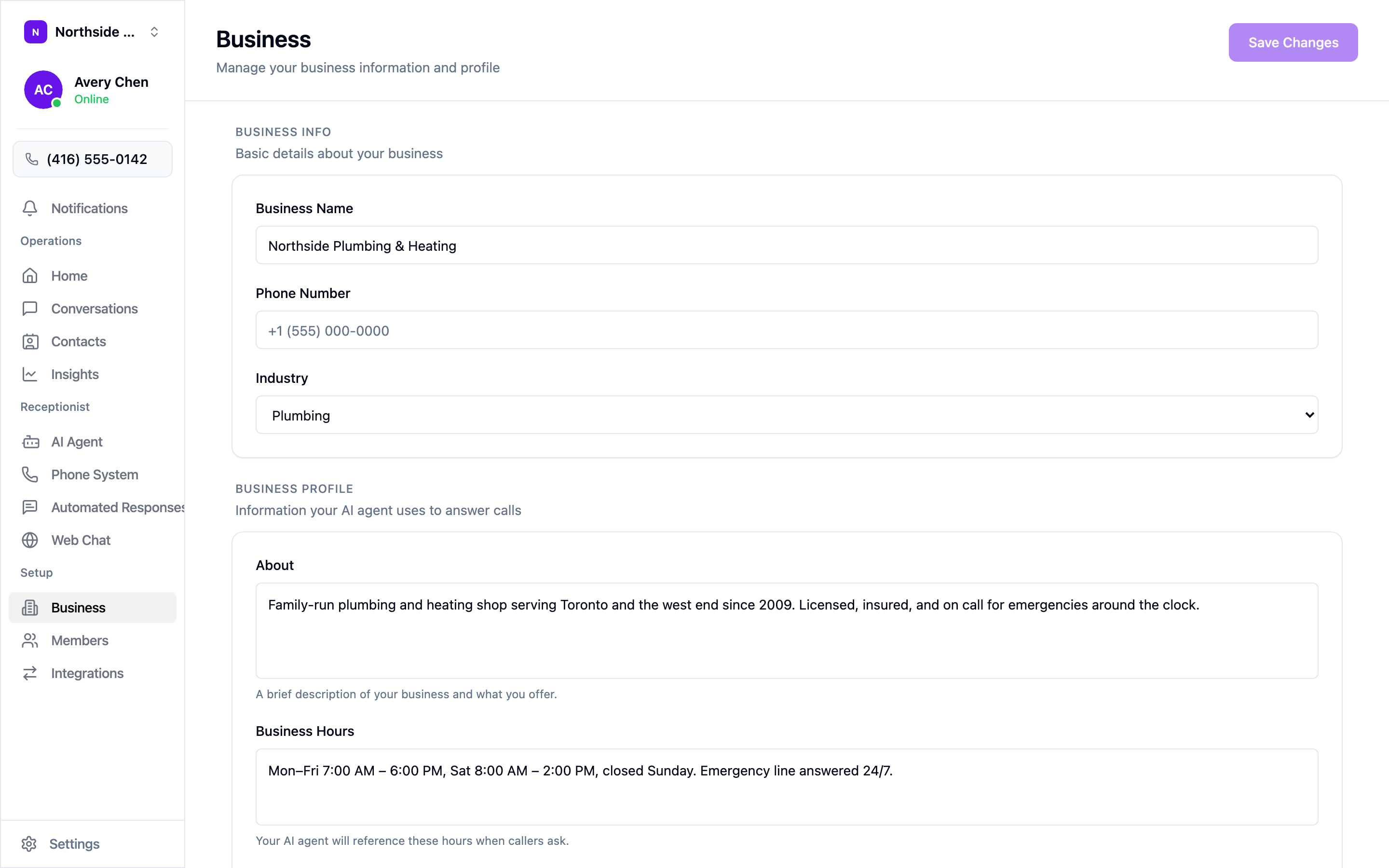
Open Business in the sidebar. The top section holds your business name, phone number, and industry. Underneath, Business Profile is what your agent actually reads on calls:
- About — a short description of what you do. Include the areas you serve and anything that qualifies a caller, like “licensed and insured” or “since 2009”. A few sentences is plenty.
- Business Hours — write these the way you’d say them, not as a table. “Mon–Fri 7:00 AM – 6:00 PM, Sat 8:00 AM – 2:00 PM, closed Sunday. Emergency line answered 24/7.” Your agent references this when callers ask if you’re open.
If setup filled these in from your website, read them before you trust them — websites go stale, and holiday hours are the usual casualty.
Select Save Changes when you’re done.
Teaching rules in plain English
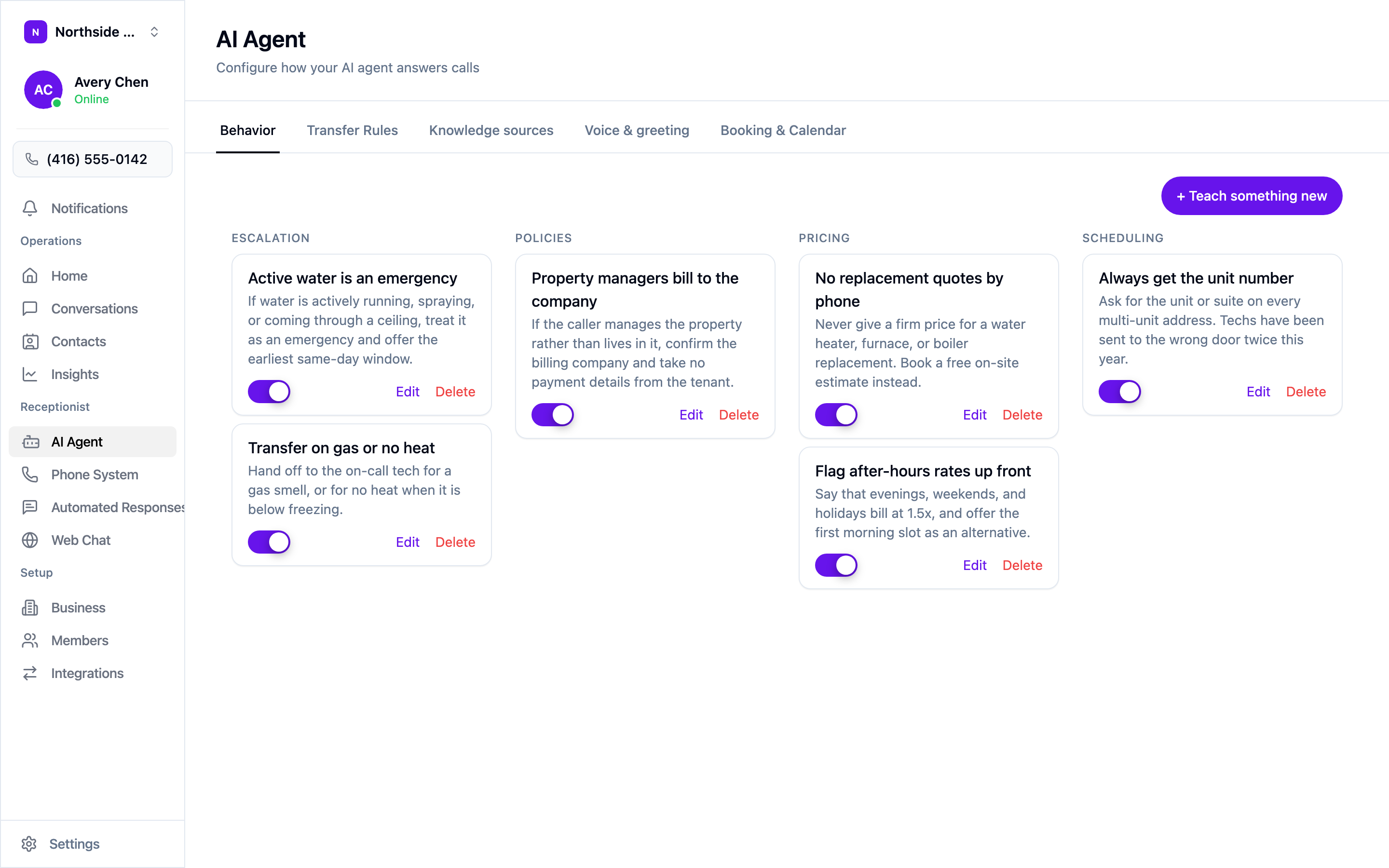
The profile describes your business. AI Agent → Behavior is where you tell your agent how to act on it, in plain English. Choose + Teach something new and write the rule the way you’d explain it to a new receptionist on their first day.
Rules are grouped into columns by category — escalation, policies, pricing, scheduling — and each one has a toggle, so you can switch a rule off for a while without deleting it. That’s useful for seasonal rules: a “flag after-hours rates up front” rule can go quiet in the summer and come back in December.
Good rules are specific about the trigger and the response:
| Instead of | Write |
|---|---|
| “Be careful about emergencies” | “If water is actively running, spraying, or coming through a ceiling, treat it as an emergency and offer the earliest same-day window.” |
| “Don’t quote prices” | “Never give a firm price for a water heater, furnace, or boiler replacement. Book a free on-site estimate instead.” |
| “Get the address” | “Ask for the unit or suite on every multi-unit address.” |
The pattern is when X, do Y. Rules that only describe a mood give the agent nothing to act on.
Start with the three or four situations that cost you the most when they go wrong — the emergency you need dispatched today, the quote you don’t want given over the phone, the detail your techs keep arriving without. You can always add more once you’ve listened to a few calls.
Knowledge sources
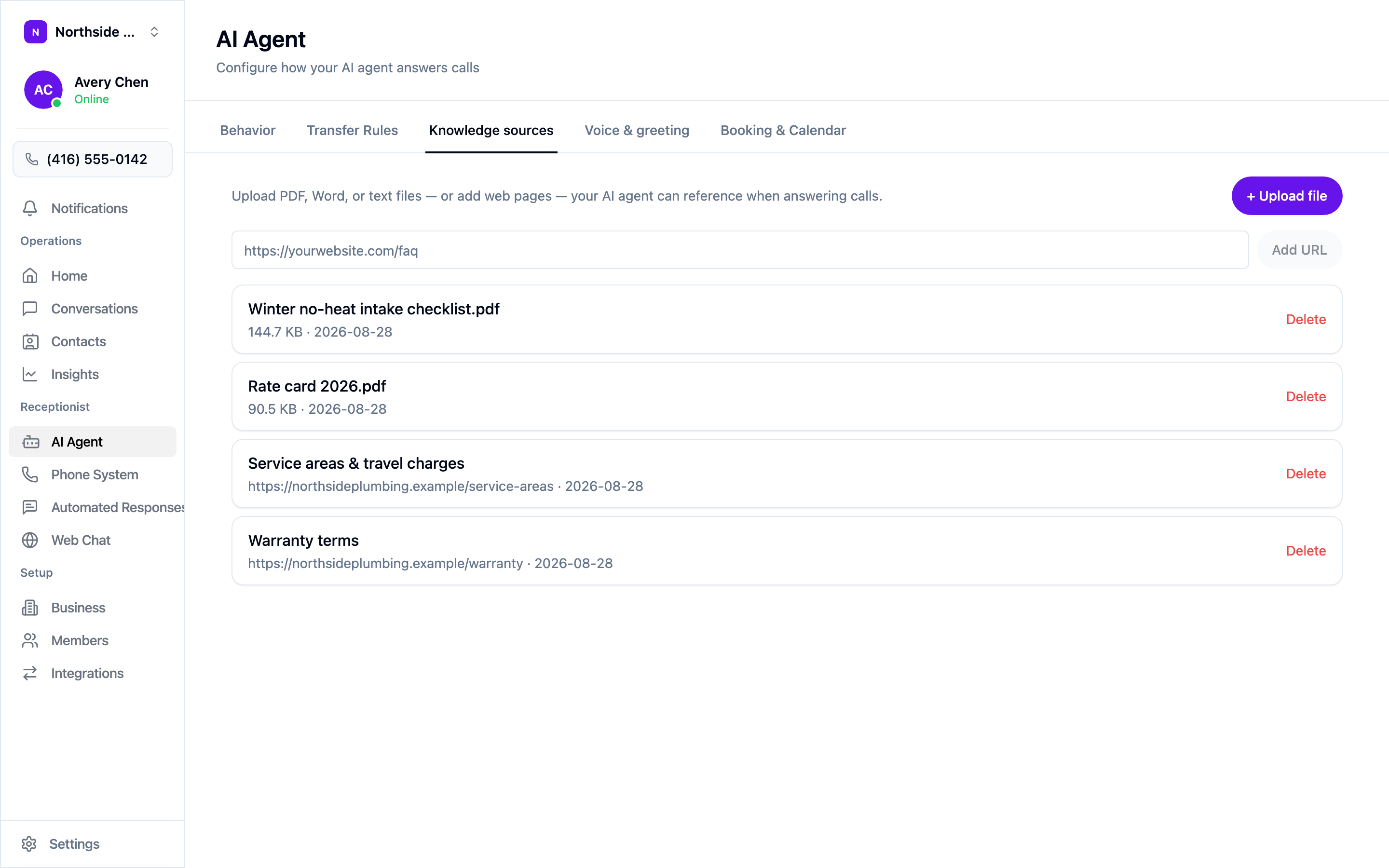
For anything longer than a few sentences, use AI Agent → Knowledge sources. Upload PDF, Word, or text files, or paste in a web page address, and your agent can reference them when answering calls.
This is the right home for:
- Rate cards and price lists
- Warranty and guarantee terms
- Service area maps and travel charges
- Intake checklists for specific job types
- Policy documents you’d otherwise re-explain on every call
To add a file, choose + Upload file. To add a page, paste the address into the field and choose Add URL. Each source lists its size or address and the date it was added, and can be removed with Delete.
Keeping sources accurate
An out-of-date rate card is worse than no rate card — your agent will quote from it confidently. When prices change, delete the old file and upload the new one rather than adding a second copy, and give files dated names like “Rate card 2026.pdf” so you can tell at a glance which is current.
Knowledge sources answer questions. They don’t change behaviour. If you want the agent to refuse to quote a price rather than read one out, that’s a rule on the Behavior tab, not a file.